Exploring Mutually Compensative Pseudo Solutions in Primary Energy Spectra of Cosmic Rays
This study delves into the existence of mutually compensative pseudo solutions in the primary energy spectra of cosmic rays, particularly in the knee region. Using data from the GAMMA experiment, we investigate the uniqueness problem regarding detected Extensive Air Showers (EAS) size spectra and their relation to unknown primary energy spectra. Through computational analysis and Monte Carlo simulations, we explore the domains of these pseudo solutions which may yield significant implications for interpreting cosmic ray data. Our findings suggest that these pseudo solutions are prevalent and essential for understanding cosmic ray behavior.

Exploring Mutually Compensative Pseudo Solutions in Primary Energy Spectra of Cosmic Rays
E N D
Presentation Transcript
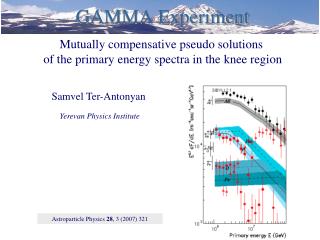
GAMMA Experiment Mutually compensative pseudo solutions of the primary energy spectra in the knee region Samvel Ter-Antonyan Yerevan Physics Institute Astroparticle Physics 28, 3 (2007) 321
EAS Inverse Problem Detected EAS size spectra X=d2F/dNedNm Unknown primary energy spectra; A H, He,…,Fe Kernel function {A,E} X The problem of uniqueness Let NA=1 andf(E)is a solution. Then f(E)+g(E) is also a solution if onlyW(E,X) g(E) dE << F(X) g(E) - oscillating functions
Problem of uniqueness for NA>1 and Mutually compensative pseudo solutions forNA > 1 the pseudo solutions fA(E)+gA(E) exist if only WA(E,X) gA(E) dE =0(F) A - WA(E,X) gA(E) dE = WA(E,X) gA(E) dE + 0(F) k mk NA nc=C NA number of possible combinations of pseudo functions: j j=2 at NA=5, nc=26
How can we find the domains of pseudo solutions ? WA(E,X) gA(E) dE =0(F) A 1.In general, it is an open question for mathematicians. 2.Our approach: a) Computationof WA(E,X) b) for given fA(E) F(X) c) Quest for | gA(,, | E) | 0from Using 2-minimization
Simulation of KASCADE EAS spectra Reconstructed EAS size spectra EAS spectra atobservation level 2D Log-normal probability density funct. CORSIKA, NKG, SIBYLL2.1 e(A,E)=<Ln(Ne)> (A,E)=<Ln(N)> e(A,E), (A,E) (Ne,N|A,E) E 1, 3.16, 10, 31.6, 100 PeV; A p,He,O,Fe n 5000, 3000, 2000, 1500, 1000 2/n.d.f. 0.4-1.4;2/n.d.f. <1.2 (E|LnNe,LnN)=0.97; (LnA|LnNe,LnN)=0.71
Quest for pseudo solutions Monte-Carlo method Abundance of nuclei: 0.35; 0.4; 0.15; 0.1 WA(E,X) gA(E) dE = 0(F) A i=1,…60; j=1,…45 Ne,min=4103, N,min =6.4 104
Examples of pseudo solutions, 1 WA(E,X) gA(E) dE = 0(F) N=7105, Em=1 PeV, 2=1.08
Examples of pseudo solutions, 2 WA(E,X) gA(E) dE = 0(F) N=7105, Em=1 PeV, 2=1.1
Examples of pseudo solutions, 3 WA(E,X) gA(E) dE = 0(F) P=3 PeV =1 at E < A =5 at E > A N=7106 ; 2=2.01 N=7105 ;2=0.25
Examples of pseudo solutions, 4: Light and Heavy components WLight(E,X) gLight(E) dE = WHeavy(E,X) gHeavy(E) dE 0(F) A p, He ( Light ) A O, Fe ( Heavy ) N=7105, Em=1 PeV, 2=1.0
CONCLUSION GAMMA Experiment • The results show that the pseudo solutions with mutually compensative effects exist and belong to all families – linear, non-linear and even singular in logarithmic scale. • The mutually compensative pseudo solutions is practically impossible to avoid at NA>1. The significance of the pseudo solutions in mostcases exceeds the significance of the evaluatedprimary energyspectra. • All-particle energy spectrum are indifferent toward the pseudo solutions of elemental spectra. To decrease the contributions of the mutually compensative pseudo solutions one may apply a parameterization of EAS inverse problem using a priori (expected from theories)known primary energy spectra with a set of free spectralparameters. Just this approach was used in the GAMMA experiment.