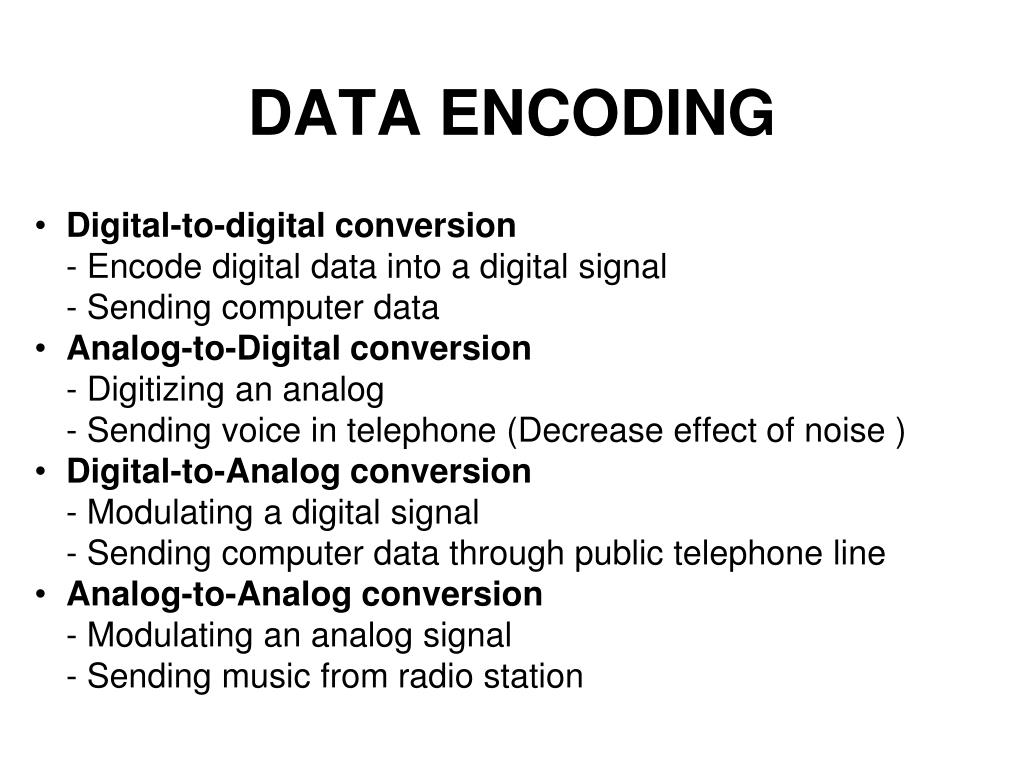
DATA ENCODING. Digital-to-digital conversion - Encode digital data into a digital signal - Sending computer data Analog-to-Digital conversion - Digitizing an analog - Sending voice in telephone (Decrease effect of noise ) Digital-to-Analog conversion - Modulating a digital signal
Une image / un lien ci-dessous est fourni (tel quel) pour télécharger la présentation
Politique de téléchargement : le contenu du site vous est fourni TEL QUEL pour votre information et votre usage personnel ; il ne peut être vendu, concédé sous licence ni partagé sur d’autres sites sans l’accord de son auteur.Le contenu vous est fourni TEL QUEL, pour votre information et votre usage personnel uniquement.Téléchargez la présentation en cliquant sur ce lien.Lors du téléchargement, si vous ne parvenez pas à télécharger une présentation, l’éditeur a peut-être supprimé le fichier de son serveur.Pendant le téléchargement, si vous ne parvenez pas à obtenir une présentation, le fichier a peut-être été supprimé par l’éditeur.
F I N
Plus de contenu associé
Transcription de la présentation
DATA ENCODING Digital-to-digital conversion - Encode digital data into a digital signal - Sending computer data Analog-to-Digital conversion - Digitizing an analog - Sending voice in telephone (Decrease effect of noise ) Digital-to-Analog conversion - Modulating a digital signal - Sending computer data through public telephone line Analog-to-Analog conversion - Modulating an analog signal - Sending music from radio station
Data Encoding - Representative Reasons • Digital information, digital signal: In general, the equipment for encoding digital information into a digital signal is less complex and less expensive than digital-to-analog equipment. • Analog information, digital signal: Conversion of analog information to digital form permits the use of modern digital transmission and switching equipment. • Digital information, analog signal: Some transmission media, such as optical fiber and satellite, will propagate only analog signals. • Analog information, analog signal: Analog information is easily converted to an analog signal.
Advantages of Digital Transmission • a) Cost. The advent of large-scale integration (LSI) and very-large-scale integration (VLSI) has caused a continuing drop in the cost and size of digital circuitry. Analog equipment has not shown a similar drop. Furthermore, maintenance costs for digital circuitry are a fraction of those for analog circuitry. • b) Data Integrity. With the use of digital repeaters rather than analog amplifiers, the effects of noise and other signal impairments are not cumulative. Thus, it is possible to transmit data longer distances and over lower-quality lines by digital means while maintaining the integrity of the data. • c) Capacity Use. It has become economical to build transmission links of very high bandwidth, including satellite channels and optical fiber. A high degree of multiplexing is needed to effectively use such capacity, and this is more easily and cheaply achieved with digital (time-division) rather than analog (frequency-division) techniques. • d) Security and Privacy. Encryption techniques can be readily applied to digital data and to analog data that have been digitized. • e) Integration. By treating both analog and digital information digitally, all signals have the same form and can be treated similarly. Thus, economies of scale and convenience can be achieved by integrating voice, video, image, and digital data.
Example 1 • A signal has two data levels with a pulse duration of 1 ms. We calculate the pulse rate and bit rate as follows: • Pulse Rate = 1/10-3= 1000 pulses/s • Bit Rate = Pulse Rate x log2L = 1000 x log22 = 1000 bps
Example 2 • A signal has four data levels with a pulse duration of 1 ms. We calculate the pulse rate and bit rate as follows: • Pulse Rate = 1000 pulses/s • Bit Rate = Pulse Rate x log2L = 1000 x log24 = 2000 bps
Unipolar Encoding • Problems • DC components - Cannot pass through some media (is not supported by some transmission media) • Synchronization problems can occur when the data contains long string of 1’s or 0’s - Beginning/ending problem (1111111111) - Distortion (four 1111 " five 11111) - Solved by separate line
NRZ-L - Similar to unipolar with average zero value • - Uses two levels +V and –V. In NRZ In NRZ-L the level of the signal is L the level of the signal is dependent upon the state of the bit. - Still susceptible to synchronization problems • NRZ-I - Invert on ones - A transition (low-to-high or high-to-low) at the start of a bit interval denotes a 1 bit, no transition denotes a 0 bit - Will still be pray to synchronization problems 50% of the time
Polar Encoding • RZ (Return to Zero) - Three levels (+ - 0) - 2 signal changes per bit " more BW + Synchronization
Note: • A good encoded digital signal must A good encoded digital signal must contain a provision for contain a provision for synchronization.
Manchester and Differential Manchester Encoding • In Manchester encoding, the transition at the middle of the bit is used for both synchronization and bit representation. • In differential Manchester encoding, the transition at the middle of the bit is used only for synchronization. The bit representation is defined by the inversion or noninversion at the beginning of the bit.
Bipolar • In bipolar encoding, we use three levels: positive, zero, and negative. Alternate Mark Inversion (AMI) • “1” are positive and negative alternately • (- Long Steam of 0 + DC component = 0)
Pulse Amplitude Modulation • Note: • Pulse amplitude modulation has some applications, but it is not used by itself in data communication. However, it is the first step in another very popular conversion method pulse code modulation.
Nyquist theorem • According to the Nyquist theorem, the sampling rate must be at least 2 times the highest frequency. • Example What sampling rate is needed for a signal with a bandwidth of 10,000 Hz (1000 to 11,000 Hz)? Solution The sampling rate must be twice the highest frequency in the signal: Sampling rate = 2 x (11,000) = 22,000 samples/s
Nyquist Theorem • We want to digitize the human voice. What is the bit rate, assuming 8 bits per sample? Solution The human voice normally contains frequencies from 0 to 4000 Hz. Sampling rate = 4000 x 2 = 8000 samples/s Bit rate = sampling rate x number of bits per sample = 8000 x 8 = 64,000 bps = 64 Kbps