Download
1 / 11
110 likes | 254 Vues
Elia Kazan remains a controversial figure in Hollywood history due to his involvement with the House Un-American Activities Committee (HUAC) in the 1950s. Known for his groundbreaking directorial work in films like "A Streetcar Named Desire" and "On the Waterfront," Kazan's testimony before HUAC and naming former Communist Party members put his career in jeopardy while also rescuing it. This complex narrative examines the moral dilemmas of artists during the Red Scare and the lasting legacy of the Hollywood blacklist.

E N D
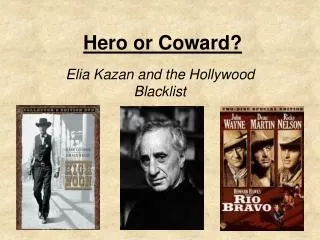
Hero or Coward? Elia Kazan and the Hollywood Blacklist
Background of the HUAC • House Un-American Activities Committee • 1938 – Developed to battle anti-American ideals • Particularly battled Communism (Red Scare)
Hollywood Blacklist • Specifically targeted those in the entertainment industry • Hollywood Ten (Nov. 25, 1947) • Officially ended nearly 13 years later
The List http://en.wikipedia.org/wiki/Hollywood_blacklist
Response High Noon (1952) Rio Bravo (1959)
Elia Kazan • Sept. 7, 1909 • Actor’s Studio • Quickly became a Significant talent in Hollywood • A Streetcar Named Desire (1951)
Testimony • Called upon HUAC in 1952 • Named 8 former members of the American Communist Party, • Decision cost him many friends, but was able to save his own career. • “Anybody who informs on other people is doing something disturbing and even disgusting.” -Elia Kazan
On the Waterfront (1954) • Tells the story of Terry Malloy, a small time gangster played by Marlon Brando. • Kazan’s justification. • Won 8 Oscars (Best Director)
Legacy His testimony was still considered controversial up until his death in 2003. http://www.youtube.com/watch?v=3YziNNCZeNs
Works Cited “Waterfront Labor Corruption.” Youtube. Web. 15 Nov 2010 Davies, Philip and Neve, Brian, ed. Cinema, Politics, and Society in America. New York: St. Michael’s Press, 1981.