Carbohydrates: Fun Facts, Structures, and Reactions
Explore the fascinating world of carbohydrates with these fun facts, learn about monosaccharides and their structures, and discover the various reactions and properties of carbohydrates.

Carbohydrates: Fun Facts, Structures, and Reactions
E N D
Presentation Transcript
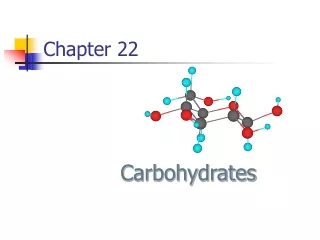
Chapter 22 Carbohydrates
Carbohydrates • Fun Facts: • Photosynthesis converts more than 100 billion metric tons of CO2 and H20 into carbohydrates annually. • Non-photosynthetic cells can make there own glucose from amino acids, fats and other breakdown products.
Carbohydrates • Fun Facts 2 • Mole Ratios 1C, 2H, 1O • Empirical Formula = CH2O • monosaccharides have from 3 to 8 carbons • aldose: linear sugar with an aldehyde group • ketose: linear sugar with a ketone group
Carbohydrates • Fun Facts 3 • Three classes of carbohydrates • Monosaccharides • 3 to 8 carbons with carbonyl and alcohol FG • Disaccharides • 2 monosaccharides connected with a ketal or acetal connection • Polysaccharides • Multiple ketal or acetal connections
Monosaccharides • Monosaccharides are classified by their number of carbon atoms
Monosaccharides • And they differ by the type of carbonyl present • Aldehyde • Ketone
Monosaccharides • There are only two trioses • often aldo- and keto- are omitted and these compounds are referred to simply as trioses
Monosaccharides • Glyceraldehyde, the simplest aldose, contains a stereocenter and exists as a pair of enantiomers
Monosaccharides • Fischer projection:a two dimensional representation for showing the configuration of tetrahedral stereocenters • horizontal lines represent bonds projecting forward • vertical lines represent bonds projecting to the rear
D,L Monosaccharides • Emil Fischer decided on of D- and L- assignments for the enantiomers of glyceraldehyde • D-monosaccharide: the -OH is on the right • L-monosaccharide: the -OH is on the left
D,L Monosaccharides • the most common D-tetroses and D-pentoses
D,L Monosaccharides • the three common D-hexoses
Amino Sugars • Amino sugars contain an -NH2 group in place of an -OH group
Cyclic Structure • Aldehydes and ketones react with alcohols to form hemiacetals • cyclic hemiacetals form readily as five- or six-membered ring
Haworth Projections • D-Glucose forms these cyclic hemiacetals
Haworth Projections • a five- or six-membered cyclic hemiacetal is represented as a planar ring • groups lie either above or below the plane • the new carbon stereocenter is called an anomeric carbon • stereoisomers that differ in configuration only at the anomeric carbon are called anomers • the anomeric carbon of an aldose is C-1; that of the most common ketoses is C-2
Haworth Projections • Terminology of carbohydrate chemistry, • b means that the anomeric -OH is on the same side of the ring as the terminal -CH2OH • a means that the anomeric -OH is on the side of the ring opposite the terminal -CH2OH • a six-membered hemiacetal ring is called a pyranose, and a five-membered hemiacetal ring is called a furanose
Haworth Projections • aldopentoses also form cyclic hemiacetals • the most prevalent forms of D-ribose and other pentoses in the biological world are furanoses
Haworth Projections • D-fructose also forms a five-membered cyclic hemiacetal
Mutarotation • Mutarotation: the equilibrium interconversion of a- and b-anomers in aqueous solution
Chair Conformations Pg 475 • Lets leave this out. I will be very happy if you can draw Fisher and Hayworth forms.
Physical Properties • Monosaccharides are colorless crystalline solids, very soluble in water • sweetness relative to sucrose:
Chemical Properties • Monosaccharides • Hemiacetal into acetal – glycosidic bond • A glycosidic bond slows mutarotation to snails pace. • Acid is needed to break acetal or ketal • Aldose’s reduce Cu2+, Fe3+, and cold MnO4- • Only works with the linear aldehyde form • Hemiacetals are in equilibrium with aldehyde form • Called reducing sugars • Glycosides cannot reduce these • Carbonyl can be reduced
Formation of Glycosides • Treatment of a monosaccharide with an alcohol gives an acetal
Glycosides • a cyclic acetal derived of a monosaccharide is called a glycoside • the bond from the anomeric carbon to the -OR group is called a glycosidic bond • mutarotation is VERY SLOW in a glycoside • glycosides are stable in water and aqueous base, but like other acetals, are hydrolyzed in aqueous acid to an alcohol and a monosaccharide
Oxidation to Aldonic Acids • the aldehyde group of an aldose is oxidized under basic conditions to a carboxylate anion • the oxidation product is called an aldonic acid • reducing sugar (it reduces the oxidizing agent)
Oxidation to Uronic Acids • Enzyme-catalyzed oxidation of the primary alcohol at C-6 of a hexose yields a uronic acid • enzyme-catalyzed oxidation of D-glucose, for example, yields D-glucuronic acid
Reduction to Alditols • The carbonyl group can be reduced to a hydroxyl group by NaBH4 and H2/Pd • the reduction product is called an alditol
Reduction to Alditols • sorbitol is found in the plant world in many berries and in cherries, plums, pears, apples, seaweed, and algae • it is about 60 percent as sweet as sucrose • these three alditols are also common in the biological world
D-Glucuronic Acid • D-glucuronic acid exists in the plants and animals • in humans, it is an important component of the acidic polysaccharides of connective tissues • it is used to detoxify foreign phenols and alcohols; in the liver, these compounds are converted to glycosides of glucuronic acid and excreted in the urine
Phosphate Esters • Mono- and diphosphoric esters are intermediates in metabolism of monosaccharides • the first step in glycolysis is conversion of D-glucose to a-D-glucose 6-phosphate
Disaccharides • Sucrose • most abundant disaccharide • sucrose is a nonreducing sugar (why)
Disaccharides • Lactose • lactose is the principal sugar present in milk • it consists of D-galactopyranose bonded by a b-1,4-glycosidic bond to carbon 4 of D-glucopyranose • lactose is a reducing sugar (why)
Disaccharides • Maltose • present in malt • two D-glucopyranose joined by an a-1,4-glycosidic bond • maltose is a reducing sugar (Why)
Polysaccharides • Polysaccharide: lots of monosaccharide units • Also called glycans • Can be a or b linked anomers • One we can digest “a” • The other we cannot “b”
Polysaccharides - a • Starch: an energy storage polymer of D-glucose found in plants • starch can be separated into amylose and amylopectin • amylose is D-glucose units joined by a-1,4-bonds • Amylopectin - D-glucose units joined by a-1,4 bonds; at branch points, new chains every 24 to 30 units are started by a-1,6-glycosidic bonds
Polysaccharides - a • Glycogen is the energy-reserve carbohydrate for animals • glycogen - glucose units joined by a-1,4- and a-1,6-glycosidic bonds (branches occur every 8 to 12 residues - more compact than starch) • the total amount of glycogen in the body of a well-nourished adult human is about 350 g, divided almost equally between liver and muscle
Polysaccharides - a • Why Store sugar as starch or glycogen? • Osmolarity • Individual sugars would be 0.4 M • Polymers (mostly insoluable) 10-8 M • Cells would burst with water running into the to equilibrate osmotic pressure!
Polysaccharides - b • Cellulose is a linear polysaccharide of D-glucose units joined by b-1,4-glycosidic bonds • it has an average molecular weight of 400,000 g/mol, approximately 2200 glucose units • cellulose molecules act like stiff rods and align themselves side by side into well-organized water-insoluble fibers in which the OH groups hydrogen bond with each other rather than water. • this arrangement of parallel chains in bundles gives cellulose fibers their high mechanical strength • it is also the reason why cellulose is insoluble in water
Polysaccharides - b • Cellulose (cont’d) • animals cannot digest cellulose • no contain b-glucosidases, enzymes that catalyze hydrolysis of b-glucosidic bonds • we have only a-glucosidases; hence we can digest starch and glycogen • many bacteria and microorganisms have b-glucosidases and can digest cellulose • termites have such bacteria in their intestines and can use wood as their principal food
Acidic Polysaccharides • Acidic polysaccharides: contain carboxyl groups and/or sulfuric ester groups • play important roles in the structure and function of connective tissues • there are a large number of highly specialized forms of connective tissue • such as cartilage, bone, synovial fluid, skin, tendons, blood vessels, intervertebral disks, and cornea • most connective tissues are made up of collagen, a structural protein, in combination with a variety of acidic polysaccharides
Acidic Polysaccharides • Hyaluronic acid • Found in embryonic tissues, synovial fluid, lubricant of joints in the body, and the vitreous of the eye
Acidic Polysaccharides • Heparin:a heterogeneous mixture of variably sulfonated polysaccharide chains, ranging in molecular weight from 6,000 to 30,000 g/mol
Acidic Polysaccharides • Heparin (cont’d) • heparin is synthesized and stored in mast cells of various tissues, particularly the liver, lungs, and gut • the best known and understood of its biological functions is its anticoagulant activity • it binds strongly to antithrombin III, a plasma protein involved in terminating the clotting process
Carbohydrates End Chapter 19