Understanding Elastic and Inelastic Collisions: Momentum and Energy Conservation
This text provides a comprehensive overview of elastic and inelastic collisions, focusing on the conservation of momentum and energy during these events. It explains how to calculate momentum using the formula ( p = mΔv ) and energy with ( KE = frac{1}{2}mv^2 ). Elastic collisions, where momentum and kinetic energy are conserved, differ from inelastic collisions, where momentum is conserved but kinetic energy is not. Key equations and processes are clearly outlined for both types of collisions, enhancing understanding of dynamics in physics.

Understanding Elastic and Inelastic Collisions: Momentum and Energy Conservation
E N D
Presentation Transcript
Analyzing Collisions elastic & Inelastic
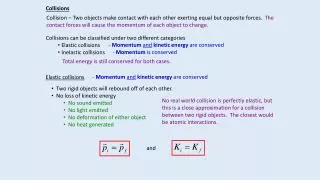
Collisions • During a collision, there is a transfer of momentum & energy. • To calculate momentum = pai + pbi = paf + pbf (remember p = mΔv) • To calculate energy = KEai + KEbi = KEaf + KEbf (remember KE = ½ mv2)
Collisions • 2 types of collisions #1 = Elastic – “hit & rebound” - momentum is conserved For Perfectly Elastic - KE remains the same
Collisions: hit and rebound ma vainitial mb vbinitial P before = ma(+va) + mb(-vb) ma vafinal mb vbfinal P after = ma(-va) + mb(+vb)
Collisions: hit and rebound Elastic Collision Equation ma(+va) + mb(-vb) = ma(-va) + mb(+vb) *Positive velocity to the right *Negative velocity to the left
Collisions • 2 types of collisions #2 = Inelastic – “hit & stick” - momentum is conserved For Perfectly Inelastic - KE is decreased
Collision: hit and stick ma vainitial mb vbinitial P before = ma(+va) + mb(-vb) ma vafinal mb vbfinal vab P after = (ma+ mb)(va&b combined)
Collision: hit and stick Inelastic Collision Equation ma(+va) + mb(-vb) = (ma+ mb)(va&b combined) *Positive velocity to the right *Negative velocity to the left