Understanding Gibbs Free Energy in Chemical Reactions: Spontaneity and Non-Standard Conditions
120 likes | 254 Vues
This comprehensive overview explores the concept of Gibbs Free Energy (ΔG) and its significance in determining the spontaneity of chemical reactions. We delve into the relationship between ΔG, enthalpy (ΔH), and entropy (ΔS), presenting the equation ΔG = ΔH - TΔS. The analysis includes conditions that render reactions spontaneous (ΔG < 0) versus non-spontaneous (ΔG > 0) and the implications of equilibrium (ΔG = 0). Further, we touch on the effects of concentration (reaction quotient Q) and temperature on Gibbs Free Energy, with practical examples to illustrate these concepts.


Understanding Gibbs Free Energy in Chemical Reactions: Spontaneity and Non-Standard Conditions
E N D
Presentation Transcript
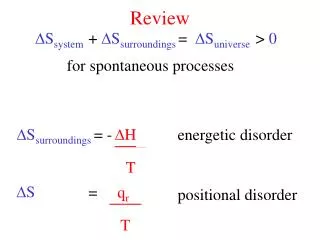
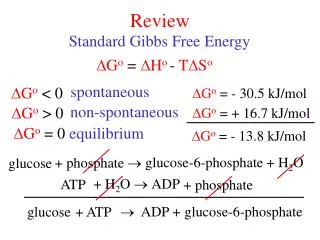
Review Standard Gibbs Free Energy Go = Ho - TSo spontaneous Go < 0 Go = - 30.5 kJ/mol non-spontaneous Go > 0 Go = + 16.7 kJ/mol Go = 0 equilibrium Go = - 13.8 kJ/mol glucose-6-phosphate + H2O + phosphate glucose + H2O ADP ATP + phosphate ADP + glucose-6-phosphate glucose + ATP
Non-standard conditions = [products] m reaction quotient Q = initial [reactants] n initial equilibrium constant K = = [products] m equilibrium [reactants] n equilibrium /Q G = - RT ln ( ) K G < 0 K > Q spontaneous G > 0 non-spontaneous K < Q G = 0 K = Q equilibrium
Go G = - RT ln(K/Q) Impose Standard conditions: [reactants]initial = 1(M or atm) = [products]initial Q = 1 G = - RT ln(K) o Standard Free Energy
Non-Standard Conditions G = Go + RT ln Q G = - RT ln (K/Q) Go = - RT ln K ln (a/b) = ln a - ln b G = - RT ln (K/Q) = + RT ln Q -RT ln K
Go = - RT ln(K) + phosphate glucose-6-phosphate + H2O glucose -RT -RT /Q G = - RT ln ( ) K G < 0 [products] initial [reactants] initial standard conditions non-spontaneous Go = 16.7 kJ/mol = -RT ln K K = 1.2 x 10⁻³ Q < K < 1.2 x 10⁻³ non-standard conditions Q = start with no product spontaneous
Non-Standard Conditions 2NO2 (g) N2O4 (g) G = Go + RT ln Q Initially [NO2] = 0.3 M [N2O4] = 0.5 M Will more products or reactantsbe formed? Q = 0.5 / 0.32 = 5.6
Non-Standard Conditions 2NO2 (g) N2O4 (g) G = Go + RT ln Q Initially [NO2] = 0.3 M [N2O4] = 0.5 M Gorxn= Gof products - Gof reactants = 97.8 - - 4.8 kJ/mol 2(51.3) = Grxn= = -0.5 kJ/mol -4.8 + (8.314 x 10⁻³)(298) ln 5.6 More N2O4 will be formed
G = -RT ln (K/Q) K = [C]e Q = [C]i A +B C [A]e[B]e [A]i[B]i Le Chatelier’s Principle decrease Q K/Q > 1 Add A Add B > < 0 G Remove A increase Q K/Q < 1
Temperature dependence of K exothermic reaction heat = product favor forward reaction at low T favor reaction reverse at high T reactant endothermic reaction heat = favor reaction reverse at low T favor reaction forward at high T
1 T Temperature dependence of K Go = Ho - TSo Go = -RT ln K Ho - TSo -RT ln K = - Ho R + So R ln K = m x b ln K y Ho < 0 1/T increase T decrease K T
1 T Temperature dependence of K Go = Ho - TSo Go = -RT ln K -RT ln K = Ho - TSo - Ho R ln K = + So R - ln K m b y x endothermic H > 0 1/T T increase T increase K