Nuclear Energy
Nuclear energy harnesses the energy within atomic nuclei, primarily through the process of nuclear fission, where uranium-235 atoms are split, releasing neutrons which can cause a chain reaction. Controlled nuclear fission powers plants, generating heat that creates steam to drive turbines. Despite its efficiency—1 gram of uranium producing energy equivalent to 3.5 tons of coal—nuclear energy poses challenges such as radioactive waste, safety concerns, and high costs. This overview contrasts fission with fusion, the challenges of nuclear energy in Pennsylvania, and highlights both its potential and pitfalls.

Nuclear Energy
E N D
Presentation Transcript
Nuclear Energy Environmental Science Mrs. Naples
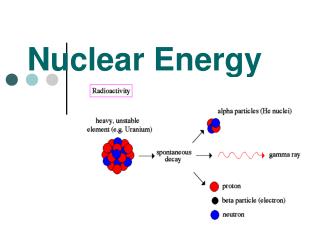
What is Nuclear Energy? • Energy that exists within the nucleus of an atom. • Atoms are split and the energy is released • Nuclear FISSION is the breaking apart of an atom
How does Fission Work? • An atom of Uranium 235 is split • Neutrons are released • The new neutrons cause other atoms to split • This is called a chain reaction
Nuclear Fission • Uranium 235 fission
Nuclear Power Plants • Nuclear reactions in a power plant are controlled. • Energy is released slowly • Tremendous heat is generated • Heat is used to boil water and create steam • Steam drives turbine which drives a generator
Nuclear Power Plants • Inside a nuclear power plant
What if it is Not Controlled? If nuclear energy is not controlled the release of energy escalates out of control. An atomic bomb is an example of nuclear energy out of control. The chain of energy will continue until all fissionable material is used up.
Atomic Bomb Explosion • Mushroom Cloud from Atomic Bomb
Advantages of Nuclear Energy • Rich energy source • 1 gram of Uranium 235 delivers about as much energy as 3.5 metric tons of coal • Nuclear energy does not create gasses such as carbon dioxide
Why Don’t We Use Nuclear Energy More? • Produces radioactive waste • No facility to dispose of nuclear waste • Short supply of Uranium 235 • Expensive to build and run plants • Safety concerns – nuclear meltdown • Reaction can get out of control and heat can destroy the buildings and spew radioactive products into the air
Nuclear Meltdown • Chornobyl– Soviet Union 1986
Radiation • Nuclear waste contains high levels of radiation • Radiation can have various negative effects on the human body and can even cause death
Fission VS. Fusion • Fission is the breaking apart of an atom • Fusion is the combining of atoms • Fusion powers our stars, including the sun • It is possible to create energy using fusion BUT it has proven to be very difficult at this time • Must be heated to extremely high temperatures • Need very high concentrations • Possibility for great amounts of energy.
Fission VS. Fusion • Fission and fusion are opposite reactions
Nuclear Energy in PA • Power plants in PA
Power Plants in the U.S. • Most power plants in the United States are on the eastern side of the country