Factory Method
The Factory Method Pattern, also known as the "Virtual Constructor," defines an interface for creating an object while allowing subclasses to determine which class to instantiate. This creational design pattern promotes loose coupling in software design, enabling classes to delegate the responsibility of object creation to helper subclasses. While it simplifies object management by eliminating application-specific class dependencies, it can require subclasses for creating certain products. This guide explores the advantages, disadvantages, and applications of the Factory Method, emphasizing its relevance in modern software frameworks.

Factory Method
E N D
Presentation Transcript
Factory Method Also known as “Virtual Constructor” Chris Colasuonno
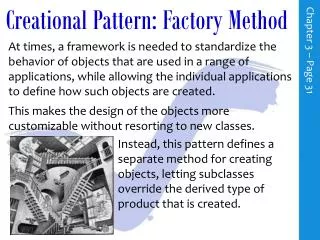
Factory Method: Defined • Define an interface for creating an object, but let the subclasses decide which class to instantiate. • (Factory Method lets a class defer instantiation to subclasses) • (Gamma et al. 107)
Factory Method: Defined • Creational
Factory Method: Motivated Application Document CreateDocument() NewDocument() Open Document() Document* doc=CreateDocument(); docs.Add(doc); doc->Open(); Open() Close() Save() MyApplication MyDocument CreateDocument() Return new MyDocument
Factory Method: Applied • When should we use Factory Method? • When a class: • Can’t predict the class of the objects it needs to create • Wants its subclasses to specify the objects that it creates • Delegates responsibility to one of multiple helper subclasses, and you need to localize the knowledge of which helper is the delagte
Factory Method: The Consequences • Advantage: • Elminates the need to bind application-specific classes to your code. • Code deals only with the Product interface (Document), so it can work with any user-defined ConcreteProduct (MyDocument)
Factory Method: The Consequences • Potential Disadvantages • Clients may have to make a subclass of the Creator, just so they can create a certain ConcreteProduct. • This would be acceptable if the client has to subclass the Creator anyway, but if not then the client has to deal with another point of evolution.
Factory Method: The Consequences • In addition: • “Provides hooks for subclasses” • “Connects parallel class hierarchies” • P.109-110
Factory Method: Implemented • Two major varieties • Parameterized factory methods • Language-specific issues • Using templates to avoid subclassing • Naming conventions
Factory Method: Known Uses • Frameworks • Toolkits
Factory Method: Related Patterns • Abstract Factory is often implemented with Factory Method. • Usually called in Template Methods • Prototypes don’t subclass the Creator, but often need to initialize the Product class. Creator would use Initialize on the object, but Factory Method doesn’t need this operation.
Sources • Gammal et al. Design Patterns: Elements of Reusable Object-Oriented Software. Addison-Wesley. 1995. • Data and Object Factory. Image: Factory.gif Internet. Available by HTTP: http://www.dofactory.com/patterns/PatternFactory.aspx
Factory Method: Notes • Text Books pages 107-116 • Slides available at www.rpi.edu/~colasc