
SlideServe
Menu
Préférences
© SlideServe · v2026

Molecular Partition Function

rinah-foreman avatar
18 diapositives · 602 Views · Nov 13, 2014

Molecular Partition Function. Diatomic Gas

Molecular Partition Function - slide 1
01 / 18Molecular Partition Function
1 / 17

Télécharger la présentation

Molecular Partition Function
Une image / un lien ci-dessous est fourni (tel quel) pour télécharger la présentation

Politique de téléchargement : le contenu du site vous est fourni TEL QUEL pour votre information et votre usage personnel ; il ne peut être vendu, concédé sous licence ni partagé sur d’autres sites sans l’accord de son auteur.Le contenu vous est fourni TEL QUEL, pour votre information et votre usage personnel uniquement. Téléchargez la présentation en cliquant sur ce lien. Lors du téléchargement, si vous ne parvenez pas à télécharger une présentation, l’éditeur a peut-être supprimé le fichier de son serveur.Pendant le téléchargement, si vous ne parvenez pas à obtenir une présentation, le fichier a peut-être été supprimé par l’éditeur.

F I N

Plus de contenu associé

Transcription de la présentation
  1. Molecular Partition Function

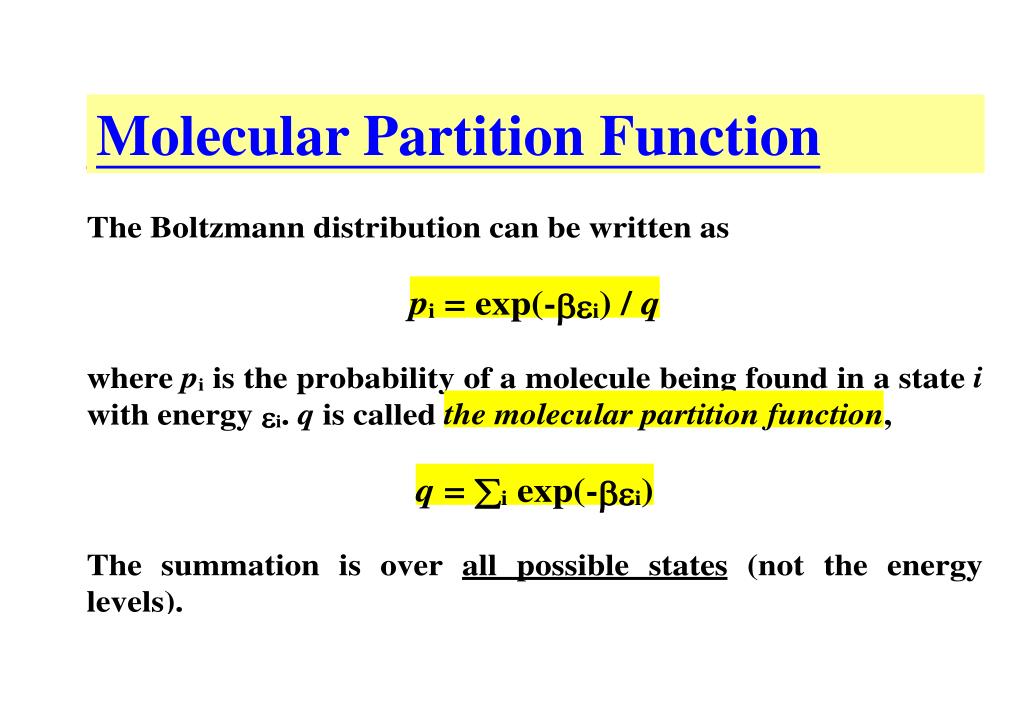
  2. Diatomic Gas Consider a diatomic gas with N identical molecules. A molecule is made of two atoms A and B. A and B may be the same or different. When A and B are he same, the molecule is a homonuclear diatomic molecule; when A and B are different, the molecule is a heteronuclear diatomic molecule. The mass of a diatomic molecule is M. These molecules are indistinguishable. Thus, the partition function of the gas Q may be expressed in terms of the molecular partition function q, The molecular partition q where, i is the energy of a molecular state I, β=1/kT, and ì is the summation over all the molecular states.

  3. Factorization of Molecular Partition Function The energy of a molecule j is the sum of contributions from its different modes of motion: where T denotes translation, R rotation, V vibration, and E the electronic contribution. Translation is decoupled from other modes. The separation of the electronic and vibrational motions is justified by different time scales of electronic and atomic dynamics. The separation of the vibrational and rotational modes is valid to the extent that the molecule can be treated as a rigid rotor.

  4. The translational partition function of a molecule ì sums over all the translational states of a molecule. The rotational partition function of a molecule  ì sums over all the rotational states of a molecule. The vibrational partition function of a molecule  ì sums over all the vibrational states of a molecule. The electronic partition function of a molecule  ì sums over all the electronic states of a molecule. where

  5. Vibrational Partition Function Two atoms vibrate along an axis connecting the two atoms. The vibrational energy levels: If we set the ground state energy to zero or measure energy from the ground state energy level, the relative energy levels can be expressed as 5--------------5hv 4--------------4hv 3--------------3hv 2--------------2hv 1--------------hv 0--------------0 n= 0, 1, 2, ……. kT  =

  6. Then the molecular partition function can be evaluated Therefore, Consider the high temperature situation where kT >>hv, i.e., Vibrational temperature v High temperature means that T>>v I2F2 HCl H2 v/K 309 1280 4300 6330 v/cm-1215 892 2990 4400 where

  7. Rotational Partition Function If we may treat a heteronulcear diatomic molecule as a rigid rod, besides its vibration the two atoms rotates. The rotational energy where B is the rotational constant. J =0, 1, 2, 3,… where gJ is the degeneracy of rotational energy level εJR Usually hcB is much less than kT, =kT/hcB B=h/8cI2 c: speed of light I: moment of Inertia hcB<<1 Note: kT>>hcB

  8. For a homonuclear diatomic molecule Generally, the rotational contribution to the molecular partition function, Where  is the symmetry number. Rotational temperature R 

  9. Electronic Partition Function =g0 =gE where, gE = g0 is the degeneracy of the electronic ground state, and the ground state energy 0E is set to zero. If there is only one electronic ground state qE = 1, the partition function of a diatomic gas, At room temperature, the molecule is always in its ground state

  10. Mean Energy and Heat Capacity The internal energy of a diatomic gas (with N molecules) (T>>1) Contribution of a molecular to the total energy Translational contribution (1/2)kT x 3 = (3/2)kT Rotational contribution (1/2)kT x 2 = kT Vibrational contribution (1/2)kT + (1/2)kT = kT kinetic potential the total contribution is (7/2)kT qV = kT/hv qR = kT/hcB The rule: at high temperature, the contribution of one degree of freedom to the kinetic energy of a molecule (1/2)kT

  11. the constant-volume heat capacity (T>>1) Contribution of a molecular to the heat capacity Translational contribution (1/2) k x 3 = (3/2) k Rotational contribution (1/2) k x 3 = k Vibrational contribution (1/2) k + (1/2) k = k kinetic potential Thus, the total contribution of a molecule to the heat capacity is (7/2) k

  12. Partition Function q = i exp(-i) = j gjexp(-j) Q = i exp(-Ei) Energy E= N i pii = U - U(0) = - (lnQ/)V Entropy S = k lnW = - Nk ipi ln pi = k lnQ + E / T A= A(0) - kT lnQ H = H(0) - (lnQ/)V + kTV (lnQ/V)T Q = qN or (1/N!)qN