Acceleration in Physics
Learn about acceleration - the rate at which velocity changes, with examples like cars speeding up, slowing down, and roller coasters. Discover the formula, units, and how to calculate acceleration in various scenarios.

Acceleration in Physics
E N D
Presentation Transcript
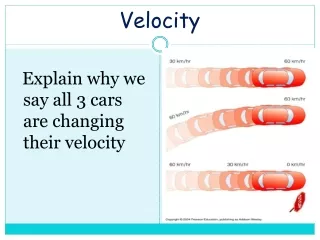
Velocity Explain why we say all 3 cars are changing their velocity
Sometimes we are interested in how fast the velocity of an object is changing • How fast is the car speeding up that is trying to pass me on the 2 lane road to Lubbock? • How fast did I slow down to avoid hitting the dog in the road? • How fast did the roller coaster go around the curve? b/c I am feeling sick!
Acceleration Definition: the rate at which velocity is changing It can be a change in 1) velocity and/or 2) direction Formula: Acceleration= velocity final – velocity initial time Unit: 10 m/s or m/s² s
Something to remember • A positive value for acceleration shows speeding up • and negative value for acceleration shows slowing down • The correct terms are positive and negative acceleration
Let’s try a few for physics fun A softball player increases her velocity from 2.0 m/s to 10.0 m/s in 3.0 seconds. What is her acceleration?
Problem #1 Looking for • Acceleration Given • Velocityinitial = 2.0 m/s • Velocityfinal = 10.0 m/s • Time = 3 seconds Relationship
Problem #2 A car accelerates at a rate of 3.0 m/s2. If its original speed is 8.0 m/s, how many seconds will it take the car to reach a final speed of 25.0 m/s?
Problem #2 Looking for • Time Given • Velocitylinitial = 8.0 m/s; Velocityfinal = 25.0 m/s • Acceleration = 3.0 m/s2 Relationship