Download
1 / 8
180 likes | 545 Vues
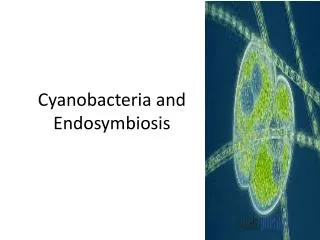
Cyanobacteria, commonly called blue-green algae, are autotrophic microorganisms found in various aquatic environments such as oceans, lakes, and moist soil. They contain chlorophyll a, phycocyanin, and phycoerythrin, giving them their characteristic colors. These prokaryotic organisms can exist as single cells, colonies, or filaments, with some forms capable of movement. Their primitive cell structure includes a dual-layered cell wall and a chromoplast containing pigments for photosynthesis. Reproduction occurs exclusively through fission, and they store photosynthetic products as starch.

E N D
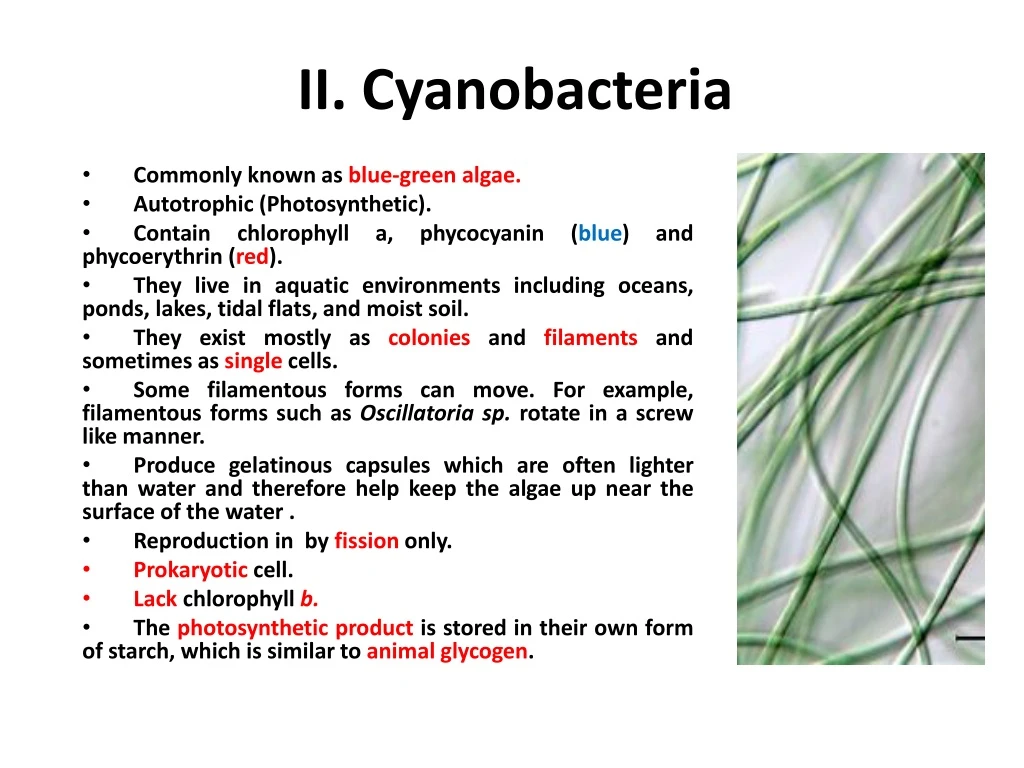
II. Cyanobacteria Commonly known as blue-green algae. Autotrophic (Photosynthetic). Contain chlorophyll a, phycocyanin (blue) and phycoerythrin (red). They live in aquatic environments including oceans, ponds, lakes, tidal flats, and moist soil. They exist mostly as colonies and filaments and sometimes as single cells. Some filamentous forms can move. For example, filamentous forms such asOscillatoria sp. rotate in a screw like manner. Produce gelatinous capsules which are often lighter than water and therefore help keep the algae up near the surface of the water . Reproduction in by fission only. Prokaryotic cell. Lack chlorophyllb. The photosynthetic product is stored in their own form of starch, which is similar to animal glycogen.
Forms of Cyanobacteria 1. Unicellular or aggregate e.g. Gloeocapsa sp
Forms of Cyanobacteria 2. Colony e.g. Microcystis sp
Forms of Cyanobacteria 3. Filamentous forms a). Unbranched e.g. Anabaena sp
Forms of Cyanobacteria 3. Filamentous forms b) Branched e.g. Stigonemasp
Cell structure • The cell structure is very primitive. • Each cell is composed of two parts: • cell wall • protoplast. The cell wall is composed of 2 layers the inner of which is thin and firm composed of cellulose. The outer layer of the wall is thicker and gelatinous known as the sheath and mainly constituted of pectic compounds. Cell wall Chromoplast Central body
Cell structure • The protoplast consists of 2 parts: • peripheral pigmented (coloured) region surrounding a colourless central region. It contains the blue pigment phycocyanin together with chlorophyll and known as chromoplasm. • The colourless inner region (central body) contains several chromatin granules (DNA) which represent a primitive type of nucleus that lacks nuclear membrane and nucleoli Cell wall Chromoplast Central body