Exploring Nucleic Acids: DNA and RNA Jeopardy Questions
Dive into the fascinating world of nucleic acids with this engaging Jeopardy quiz! Test your knowledge on DNA and RNA, covering everything from their structures, functions, and historical figures like Watson and Crick, to intricate processes such as replication, transcription, and translation. With challenging questions spanning $100 to $500, learners of all ages can enhance their understanding of genetics and molecular biology in a fun and interactive way. Perfect for classrooms, study groups, or trivia nights!

Exploring Nucleic Acids: DNA and RNA Jeopardy Questions
E N D
Presentation Transcript
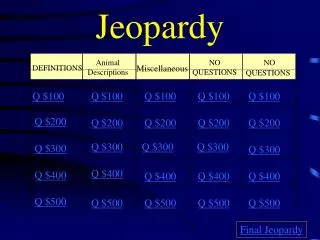
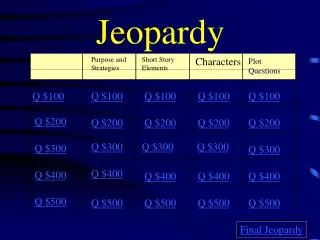
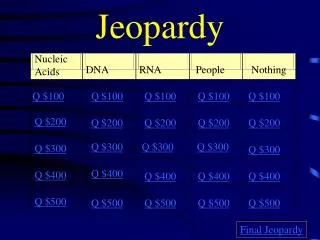
Jeopardy NucleicAcids DNA RNA People Nothing Q $100 Q $100 Q $100 Q $100 Q $100 Q $200 Q $200 Q $200 Q $200 Q $200 Q $300 Q $300 Q $300 Q $300 Q $300 Q $400 Q $400 Q $400 Q $400 Q $400 Q $500 Q $500 Q $500 Q $500 Q $500 Final Jeopardy
$100 Question from H1 Because they were first found in the nucleus of a cell
$100 Answer from H1 How did nucleic acids get their name?
$200 Question from H1 A double helix
$200 Answer from H1 What is the structural shape of DNA?
$300 Question from H1 It carries a coded message from the DNA to the ribosomes.
$300 Answer from H1 What is m-RNA? What is messenger RNA?
$400 Question from H1 The basic unit of the polymer that we call a nucleic acid.
$400 Answer from H1 What is a nucleotide?
$500 Question from H1 The partner to a phosphate molecule and a nitrogenous base making up the basic unit of DNA.
$500 Answer from H1 What is a deoxyribose sugar?
$100 Question from H2 The two alternating components of DNA siderails
$100 Answer from H2 What are sugar and phosphate?
$200 Question from H2 The significant other for guanine
$200 Answer from H2 What is cytosine?
$300 Question from H2 The AAG, CCT or GTA of DNA are examples
$300 Answer from H2 What are triplet codons?
$400 Question from H2 The long name for DNA
$400 Answer from H2 What is deoxyribonucleic acid?
$500 Question from H2 The process by which new DNA is made in the nucleus
$500 Answer from H2 What is replication?
$100 Question from H3 A single helix molecule nicknamed RNA
$100 Answer from H3 What is ribonucleic acid?
$200 Question from H3 The type that is the anticodon for m-RNA
$200 Answer from H3 What is transfer RNA? What is t-RNA?
$300 Question from H3 Pairs with t-RNA coming to the ribosome to meet m-RNA
$300 Answer from H3 What is the amino acid?
$400 Question from H3 The process by which m-RNA is produced
$400 Answer from H3 What is transcription?
$500 Question from H3 The process by which the RNA code is read and turned into a long protein polymer of amino acids
$500 Answer from H3 What is translation?
$100 Question from H4 An Englishman and an American who first described the double helix structure of DNA
$100 Answer from H4 Who are Watson and Crick?
$200 Question from H4 He has taught these same facts about nucleic acids at Post Falls High School for 33 years and still finds them exciting and interesting
$200 Answer from H4 Who is Mr. Cossette?
$300 Question from H4 The one contributor to DNA structure Who didn’t receive a Nobel Prize (Because of her death)
$300 Answer from H4 Who is Rosalind Franklin?
$400 Question from H4 She did important work with Watson and Crick (producing X-ray photos of helical DNA) but didn’t get the Nobel prize because she was deceased by that time
$400 Answer from H4 Who was Rosalind Franklin?
$500 Question from H4 Franklin’s research partner in DNA X-ray who shared the 1962 Nobel Prize for biochemistry with Watson and Crick
$500 Answer from H4 Who is Maurice Wilkins?
$100 Question from H5 It’s the NICE THING that t-RNA gives m-RNA when they meet at the ribosome
$100 Answer from H5 What is a complement?
$200 Question from H5 It is the RNA equivalent to the DNA base thymine
$200 Answer from H5 What is uracil?
$300 Question from H5 It is the shape of m-RNA
$300 Answer from H5 What is a helix?
$400 Question from H5 It is the kind of organism that doesn’t have DNA or RNA (remember the category)
$400 Answer from H5 What is “nothing”?
$500 Question from H5 They are special protein molecules that are responsible for taking care of all of the details in replication, transcription, translation, and protein synthesis