Download
1 / 10
100 likes | 204 Vues
This text provides an overview of fundamental scientific concepts, distinguishing between pure and applied science. Pure science is aimed at discovering knowledge without immediate relevance to human life, such as exploring the speed of a fast car. In contrast, applied science serves practical needs, like using phones for communication. Additionally, the text explains inference, fair testing, variables in experiments (IV, DV, CV), observations, conclusions, and different types of graphs (bar and line) to visualize data. Understanding these concepts is essential for scientific inquiry.

E N D
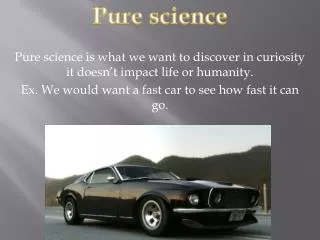
Pure science Pure science is what we want to discover in curiosity it doesn’t impact life or humanity. Ex. We would want a fast car to see how fast it can go.
Applied science Applied science we need it’s a discovery we need to make this effects humanity. Ex . We need phones to call , to get news.
Inference An inference is a logical explanation. Ex. The man is sweaty cause its hot because the sun is bright.
Fair test When you don’t change more then 1 thing in your experiment.
Iv, dv, cv Iv-the variable you change in you experiment. Dv-the variable that changes in the result of what you change. Cv- the variable that stays the same.
observations An observation is something you’ve noticed
conclusion A conclusion is the summary of your results on what you got on your experiment. Its when you summarize if it was positive or negative. When you conclude your data.
BAR GRAPH Bar graph is when your graphing comparisons this graph doesn’t involve time.
Line graph Line graph is when graphing an experiment involving time in it. Doesn't involve anything else.
Qualitative statement It’s a statement that doesn’t involve any numbers