The Boer War: A Complex History of Conflict Between Boers and British in South Africa
The Boer War (1899-1902) was marked by the complex interactions between the Dutch-descendant Boers and the British authorities in South Africa. Originating from the Dutch establishment at the Cape of Good Hope in 1652, Boers established large farms and clashed with the British over land and slavery in the 1800s. Their beliefs included a strong sense of white supremacy and the establishment of Afrikaans. The discovery of diamonds and gold intensified tensions, leading to guerrilla warfare and the British's scorched earth policy, resulting in significant loss of life. The conflict ultimately led to the formation of the Union of South Africa in 1902.

The Boer War: A Complex History of Conflict Between Boers and British in South Africa
E N D
Presentation Transcript
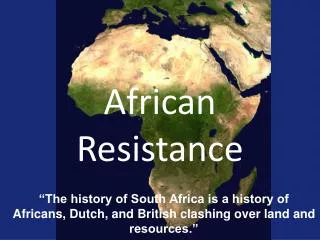
African Resistance The Boer War
History of the Boers • 1. The Dutch came to the Cape of Good Hope in 1652 to establish a way station. • 2. Boers (“farmers”) took over the land and established large farms. • 3. When the British took over the colony in the 1800’s the groups clashed over land and slavery • 4. Boers move to the North (“The Great Trek”) to escape British rule
Boer Beliefs • Believed in the supremacy of the whites • Believed that blacks were inferior; to be used as slaves • Established “Afrikaans” as a new language
British Beliefs • Abolish Slavery (Provide rights to all people) • Establish the English Language • Gave rights to “land” and “citizenship”
The Boer War (1899-1902) • 1. Diamonds and Gold discovered in 1866. • 2. Boers make effort to keep outsiders from gaining rights • 3. Boers take up arms against British in failed rebellion (after 1895 Jameson raid) • British High Commissioner places “ultimatum” on Boers to accept citizenship for the “outsiders”
Military Tactics/Strategies • 4. Boers launch commando raids and use guerilla tactics after ultimatum given by Boers to withdraw. • 5. The British implement “total war” by using scorched earth policy (burned farms to the ground). Gave rifles to “Bantu” tribesman to fight against Boers. • *Blacks told slavery would be brought back under the Boers. • *Promised land by the British
Concentration Camps • Imprisoned women and children in concentration camps totaling 116,000 (27,000 die from starvation, disease, and exposure) • Following British victory, Boer republics form Union of South Africa in 1902