Resources for the MITCET Chemistry Bridge Project: Evaluation and Licensing Insights
330 likes | 470 Vues
This document outlines the process of finding and evaluating resources for the MITCET Chemistry Bridge Project. It discusses the essential features of quality resources, such as accuracy, clarity, and interoperability. The importance of metadata for describing resources is emphasized, including elements like title, creator, and audience. Additionally, it covers licensing, particularly Creative Commons, which enables open educational resources (OER). Various platforms for discovering OERs, such as Flickr, MIT OpenCourseWare, and OER Commons, are provided as examples, along with evaluation patterns to ensure quality materials.

Resources for the MITCET Chemistry Bridge Project: Evaluation and Licensing Insights
E N D
Presentation Transcript
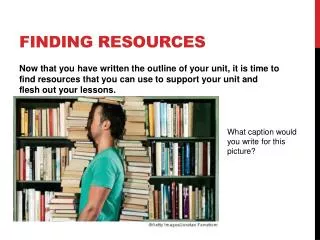
Finding Resources for The MITCET Chemistry Bridge Project Brandon Muramatsu Citation: Muramatsu, B.. (2012, February). Finding Resources for the MITCET Chemistry Bridge Project.
Outline • Process • Evaluating Resources • Describing Resources • Licenses • Resource Sites
Evaluating Resources What’s important?
What might make a good resource? • Reputable • Source • Accurate • If cross-check out • What’s said in textbooks as generally accurate?? (maybe not true) • Presentation • Clear? • Quality of video/audio • Coherent • Simplicity • Not overly complicated • Multiple formats • Alternate sources and cross-check, to help build understanding • Clear explanation, in common terms for fundamental understanding • Models, 3D representation • Interactive and manipulate • Accessibility • Captions, Colors, etc. • If printed, maintains the clarity of the printed version • Also output in multiple forms
Describing Resources Shhh…we’re going to talk about “metadata”…some consider it a four letter word.
Metadata: A brief history • U.S. MARC: Standard for metadata used by library catalogers • 1990s digital resources start to push boundaries of MARC
Enter Dublin Core and Learning Object Metadata • Dublin Core • Library Community • Started with 15 fields (simpler to get started) • Learning Object Metadata • Educators and Developers • A *lot* more fields • Richer potential Photo: Flickr @dullhunk, cc-by
What do you think we need to describe resources? • Title • Creator • Organization • URL • Short description (written by cataloger) • Purpose (written by cataloger) • To understand this content, what assumptions are you making in to what the student knows? • “What do you get out of it?” • Type of Media (video, document) • When it was created • Audience (type of Chemistry, background of user) • Rating Key: Definitely catalog Later
Brandon’s metadata list for the Chemistry Bridge Project • Title • Description (of the resource) • URL • Context (how it relates to the module) • Learning Objectives (topic and sub-topic) • Type of resource (Website, Video, Document, Simulation) • Time Point (if a video) • License (Creative Commons, other)
Licenses What can you do with the resource?
Creative Commons Licenses creativecommons.org • A “standard” way providing permissions to your work • The easiest way of communicating your resource is “open”
Advanced license topics • Using resources with different licenses
An OER walks into a bar… Finding and Recognizing OERs Demonstration
Recognizing OERs: Examples • Focusing on Creative Commons Resources • Flickr (www.flickr.com) • Google (www.google.com/advanced_search) • MIT OpenCourseWare (ocw.mit.edu) • MERLOT (www.merlot.org) • OER Commons (www.oercommons.org) • Wikipedia (www.wikipedia.org)
Have you used Flickr? • Did you know that Flickr allows photo sharers to indicate a license? • And that you can search for Creative Commons licensed photos?
Google Advanced Search http://www.google.com/advanced_search
MIT OpenCourseWare • ocw.mit.edu
MERLOT • www.merlot.org
OER Commons • www.oercommons.org
Open Course Library • www.opencourselibrary.org
Wikipedia • www.wikipedia.org
Examples of OERs • Flickr (www.flickr.com) • Some CC-licensed, find via Advanced Search • MIT Open CourseWare (ocw.mit.edu) • One of the granddaddy’s of OERs, CC-by-nc-sa • MERLOT (www.merlot.org) • Wide range of resources, complex licensing • OER Commons (www.oercommons.org) • Wide range of resources, nearly all CC-licensed • Open Course Library (www.opencourselibrary.org) • Open Textbooks, 42 published, more coming, CC-by • Wikipedia (www.wikipedia.org) • Probably the biggest OER, support for attribution
Selected additional resources • CK-12, www.ck12.org • Open University OpenLearn, www.open.edu/openlearn • Saylor Foundation, www.saylor.org • WikiEducator, wikieducator.org • Curriki, www.curriki.org • YouTube EDU, www.youtube.com/education • OpenCourseWare Consortium, www.ocwconsortium.org • Creative Commons, search.creativecommons.org • iTunesU
Questions? Brandon Muramatsu mura@mit.edu Slides will be posted to: http://slideshare.net/bmuramatsu