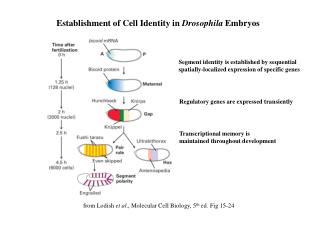
Exploiting Morphological Correspondences in Drosophila Embryos for Expression Mapping
340 likes | 448 Vues
This study focuses on enhancing the understanding of gene expression patterns in Drosophila embryos by combining measurements from multiple embryos and utilizing deformable matching techniques. By segmenting nuclei and optimizing correspondences, we aim to build composite expression maps, capturing biological variations and enabling high-throughput analysis. Our preliminary results showcase advances in visualization and shape analysis, paving the way for future exploration of genetic interactions and developmental processes. Commitments include verifying biological accuracy and refining hybridization experiment designs.


Exploiting Morphological Correspondences in Drosophila Embryos for Expression Mapping
E N D
Presentation Transcript
Finding and exploiting correspondences in Drosophila embryos Charless Fowlkes and Jitendra Malik UC Berkeley Computer Science
Motivation for combining measurements • Average noisy flouresence data over multiple embryos • High throughput • N versus N2 hybridizations to capture colocation of N gene products • Visualization of composite expression map • Study shape of expression patterns
Sources of Variation • Not so interesting: • Staining • Shrinking • Spinning • Squashing • Staging • Interesting: • Biological Variation
Overview • Finding Correspondences • Nuclear segmentation • Deformable matching • Exploiting Correspondences • Preliminary results • Discussion
x-y x-y x-z Segmenting Nuclei [C. Luengo, D. Knowles] ~200µm ~500µm Embryo is approximately 500µm by 200µm and contains about 5000 to 6000 nuclei
Mesh generation • Point cloud doesn’t capture the blastoderm topology. Locally, it is a 2D sheet of cells • Utilize off the shelf tools from computational geometry [Kolluri et al, 2004]
Clyindrical Projection Dorsal Ventral Dorsal Anterior Posterior
Overview • Finding Correspondences • Nuclear segmentation • Deformable matching • Exploiting Correspondences • Preliminary results • Discussion
Cij = disimilarity of local descriptor for points i and j Dij = distance between points i and j minimize : Σij (Cij + λDij) • Xij subject to : ΣiXij = 1 Σj Xij = 1 λ sets the relative importance of distance versus shape context match Correspondence as optimization Xij = 1 if point i is matched to point j 0 otherwise i j
Problem: correspondence may not be smooth • Find correspondence by optimizing Xij • Smoothly warp source embryo to bring into alignment with corresponding points • Repeat… Solution: iteratively correspond and warp
Overview • Finding Correspondences • Nuclear segmentation • Deformable matching • Exploiting Correspondences • Preliminary results • Composite Expression Map • Nuclear Density Map • Shape • Discussion
Preliminary Results • 34 embryos stained for ftz and one other gene product • Choose a target embryo • Find correspondences with remaining embryos and “transfer” measurements
Building a composite expression map Source Embryos Target Embryo X Y Push expression levels forward thru correspondence function X
FTZ average after coarse alignment FTZ average after detailed matching
ftz eve snail kni hb Composite Map: View #1
ftz eve snail kni hb Composite Map: View #2
Building a nuclear density map X Y Push average nuclear density forward thru correspondence function X
Shape Analysis X-1 Y-1 Pull back selected region thru inverse correspondence function.
Current/Future Work • Verifying the correspondences are biologically “correct” • Analysis of variation in shapes of expression patterns • Hybridization experiment design
Hybridization Design Sna Kni Hb Ftz Slp Eve
Hybridization Design Eve Hb Ftz Sna Sna Sna Kni Slp Kni Hb Hb Ftz Ftz Slp Eve Eve • Can build composite map from any connected graph • Error accumulates so diameter should be small • Some genes provide more powerful constraints than others