Optimizing GPP Estimation with C4/C3 LUE and fPAR Using Ameriflux Data from 2004-2006
This study employs a detailed approach to optimize Gross Primary Productivity (GPP) estimations using Light Use Efficiency (LUE) and Fraction of Photosynthetically Active Radiation (fPAR) through Ameriflux datasets collected between 2004 and 2006. Two algorithms differentiate C3 and C4 contributions while calculating fPAR based on satellite-derived data. We refine GPP estimates by minimizing discrepancies between modeled and observed data, considering varying C3/C4 distributions and shortwave radiation inputs to enhance accuracy in terrestrial carbon flux modeling.

Optimizing GPP Estimation with C4/C3 LUE and fPAR Using Ameriflux Data from 2004-2006
E N D
Presentation Transcript
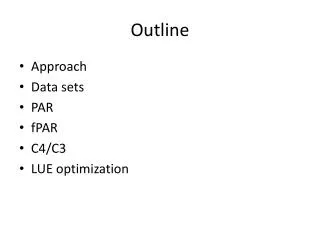
Outline • Approach • Data sets • PAR • fPAR • C4/C3 • LUE optimization
Approach • GPP = LUE × APAR = LUE × fPAR× PAR • PAR = SW × RPB • C4 and C3 LUE and fPAR algorithm
Data set: AmerifluxSite • Ameriflux GPP observations were used to minimize the discrepancy between modeled and observed GPP • Sites with more than one year data during 2004 to 2006 were chosen • Monthly GPP calculated from half-hourly GPP fluxes
Data set: fPAR products • EVI/NDVI-derived fPAR • Monthly EVI/NDVI 2004-2006 • Original: 0.05 deg • Used in model: 0.5 deg • MODIS fPAR • Monthly MODIS fPAR 2004-2006 • Original: 0.05 deg • Used in model: 0.5 deg • SeaWifsfPAR • Monthly, 2004-2006 Jan – June • Last 6 months were restructured by monthly mean from previous years • Original: 0.25 deg • Used in model: 0.5deg
Data set: radiation • GEOS-5 surface net shortwave radiation and surface albedo • 3-hourly; 2004 – 2006; 2×2.5 deg • SRB PAR and SW • Monthly; 2004-2006; 1 deg • CERES PAR and SW • Monthly; 2004-2005; 1 deg • BSRN measured SW • Monthly; 2004-2005
Data set: C4 distribution • Global C4 percentage • 1 deg • Africa C4 percentage • 1 km
EVI/NDVI-derived fPAR • Area distribution of global EVI according to biome types • Linear function applied to covert EVI/NDVI to fPAR • Upper bound: top 25% EVI of topical rainforest • Lower bound: EVI in Sahara desert with annual rainfall less than 25 mm
PAR • Adjustment for GEOS-5 shortwave radiation • Downward SW = net SW / ( 1 - albedo ) • Ratio of SRB SW to GEOS SW • Conversion from shortwave radiation to PAR • Ratio of SRB PAR to SRB SW • High temporal resolution PAR using GEOS-5 adjusted SW
C4 photosynthesis • Algorithm A • Same fPAR for C3 and C4 • Separate APAR according to C3 and C4 spatial distribution • Algorithm B • Allocate most of the fPAR seasonal cycle to C4 • Separate APAR with different fPAR for C3 and C4
C4 LUE • Lobell ratio: • Mean C4 LUE: 0.66 g C/MJ • Mean C3 LUE: 0.29 g C/MJ • Ameriflux ratio: • Cropland rotation sites • Mean C4 GPP/mean C3 GPP = 1.32
LUE optimization • A range of LUE was used to calculate GPP using the paradigm: GPP = LUE × APAR • Just account for monthly GPP from all C3 sites and rotation site with C3 crops • C4 LUE calculated from the Lobell and Ameriflux ratios