
Water Quality
E N D
Presentation Transcript
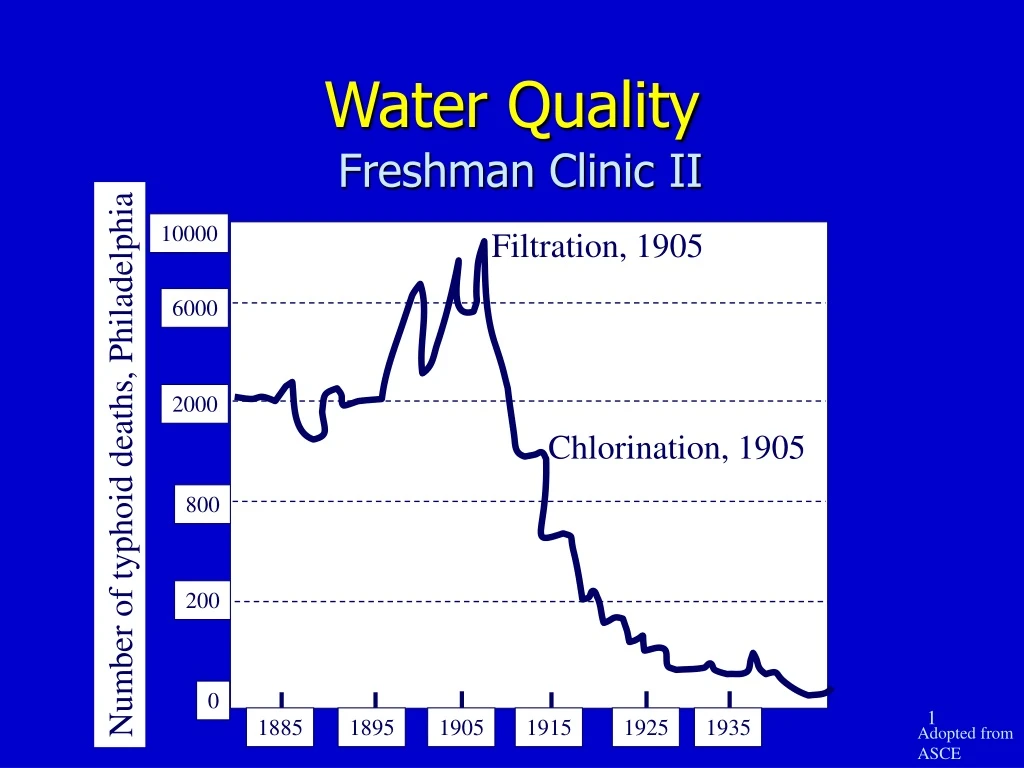
10000 Filtration, 1905 Water Quality 6000 2000 Chlorination, 1905 Freshman Clinic II Number of typhoid deaths, Philadelphia 800 200 0 1885 1895 1905 1915 1925 1935 Adopted from ASCE
Safe Drinking Water Act of 1974 • Ensure public water supply systems meet minimum standards for protection of public health • Primary Regulations • Secondary Regulations http://www.epa.gov/safewater/mcl.html
Primary Drinking Water Standards • Protection of human health • Maximum Contaminant Level Goal • Nonenforceable health goal • What we’d like to achieve • Maximum Contaminant Level • Set as close to MCLG as feasible (tech/cost) • Violation requires corrective action
Primary Standards • Organics • Pesticides, Solvents, Fuels... • Inorganics • metals... • Radionuclides • Beta particles, alpha particles, radon... • Microbials • viruses, bacteria, protozoa, helminths
Example Contaminants TT – Treatment Technology (filtration and disinfection, or alternative that achieves 99.9% removal/inactivation)
Aside - Units • Concentration • mg/l (milligrams per liter) • milli = 1/1,000 • ug/l or mg/l (micrograms per liter) • micro = 1/1,000,000 • pCi/l (picocuries per liter) • pico = 1/1,000,000,000,000 • The curie is equal to 37 billion disintegrations per second, approximately the activity of 1 gram of radium
Microbial Pathogens • Tiny living organisms that cause disease • Can be • Viruses • Bacteria • Protozoa • Helminths • But not all viruses, bacteria, protozoa, and helminths are pathogens
Measurement • Organics and Inorganics • measure for specific compound • HPLC, GC, GC-Mass Spec, AA, IC… • Radionuclides • Conduct gross tests, then specific tests • Microbes • Measure indicator organisms
Indicatororganisms • Too difficult to identify all pathogens, so we use indicator organisms • May not be pathogens themselves • If you find indicator organisms • sample might be pathogen contaminated • If you don’t • very unlikely sample is contaminated
Common Indicator Organisms • Total Coliform • Fecal Coliform • Escherichia coli • Common denominator is fecal coliform • found in intestines • evidence of fecal contamination E. Coli http://www.cellsalive.com/
Secondary Drinking Water Standards • Not health related • Not enforceable • Based on • Aesthetics • Color, odor, taste, foaming… • Cosmetic effects • Skin or tooth discoloration • Technical effects • Corrosivity, staining, scaling, sedimentation
Examples of Secondary Standards PARAMETER GOAL REASON Chloride 250 mg/L salty taste Copper 1.0 mg/L metallic taste; blue-green staining Corrosivity Non-corrosive metallic taste; corroded pipes/ fixtures staining Fluoride 2.0 mg/L tooth discoloration Foaming agents 0.5 mg/L frothy, cloudy; bitter taste; odor Iron 0.3 mg/L rusty color; sediment; metallic taste; reddish or orange staining pH 6.5 - 8.5 low pH: bitter metallic taste; corrosion high pH: slippery feel; soda taste; deposits Silver 0.1 mg/L skin discoloration; graying of the white part of the eye Sulfate 250 mg/L salty taste Total Dissolved Solids (TDS) 500 mg/L hardness; deposits; colored water; staining; salty taste
another secondary standard Odor • Threshold odor number (TON) • Goal is < 3 TON • Determined by panels of “smellers” identifying the most dilute sample they can smell • A = ml sample • B = ml odor-free water TON = (A + B) / A Electronic Noses are finding more application
another secondary standard Color • Goal is < 15 color units • True Color • vegetable or organic extracts that are dissolved or too small to filter • Also called “natural color”, usually yellowish-brown • South Jersey rivers have lots of true color • Apparent Color • suspended matter, such as red clay • Can be filtered out
Color Measurement • Traditional • chemical solutions that produce color similar to natural color • Platinum Cobalt Color Units • start w/ 500 mg/L solution K2PtCl6 • add sufficient cobalt chloride to provide proper tint • dilute to produce working standards • 1 mg/L of K2PtCl6 = 1 platinum cobalt unit • Modern • Use a spectrophotometer
Spectrophotometer Hach model DR/4000 UV VIS www.hach.com
Light Absorbance • Many solutions absorb light • Amount of absorbance function of • chemicals in solution and their concentration • distance light travels through solution • wavelength of light
Spectrophotometry • Widely used • Accurate and sensitive • Absorbance of light used to measure concentration of light absorbing compounds • If compound itself doesn’t absorb light, reactant is added that converts it to some other (light absorbing) compound Red solutions are red because they absorb blue light
Beer-Lambert law • Amount of light absorbed is proportional to number of molecules of absorbing substance in light path • Absorbtion proportional to • concentration of chromogen (light absorbing compound) • length of light path through solution
-log10(I/I0) = K c l • I and I0 = intensity of transmitted light in presence / absence of chromogen, respectively • c = concentration of chromogen • l = length of light path through solution • K = constant, characteristic for each absorbing substance at a specified wavelength of light and in a specific solvent (often water) • light transmission = I/I0, usually reported as a percent • Absorbance (Abs) is used more frequently Abs = -log10(I/I0)
Hach model DR/4000 UV VIS • Uses Deuterium Lamp and gas filled Tungsten Lamp • Narrows light down to a specific wavelength using a monochromator • Detects the difference in light through a solution photoelectrically and compares that difference electronically • The difference is expressed as percent transmission or absorbance www.hach.com
cells or cuvettes • carefully made solution containers • plane, parallel sides ensure light path is same through all portions, making it possible to tabulate values of K for various substances in various solvents and wavelengths
Color and Spectrophotometry • We can measure color in water samples using a specific wavelength of light • Measure true color of filtered water • Measure apparent color of unfiltered water
Turbidity • Clarity of water • Cause • Soil runoff, resulting in scattering of light by colloidal particles • colloidal particles are 0.001 to 1 mm • Why do we care? • Clarity relates to cleanliness • Affects treatment success of disinfection • Measurement • light transmission with standard light source, 90o detector, and glass container • Measured in NTU (Nephelometric Turbidity Units)
> 5 NTU's < 0.1 NTU Surface water typical values 11 NTU 16 NTU 26 NTU Detected visually Aesthetically objectionable Properly treated water Reservoir Lake River Some NTU Numbers
Turbidity Standard • Primary drinking water standard • Turbidity may never exceed 1 NTU, and must not exceed 0.3 NTU in 95% of daily samples in any month • Why primary? • Because water with low turbidity is less likely to be contaminated by pathogens and disinfects easier
Hach 2100N Laboratory Turbidimeter www.hach.com
Turbidimeter • Micro-processor-based model • Employs advanced optical and electronic design • Has two types of sensors • Scattering Sensor • Transmissive Sensor
Websites • EPA Office of Water • www.epa.gov/OW/ • Water Quality Company • www.hach.com • Frequently asked questions about water quality • www.sioxlan.com • Water Environment Federation • www.wef.org • American Water Works Association • www.awwa.org • Info on water treatment processes • www.culligan.com