Wavelength and Light
This article explores the relationship between wavelength and light as measured by monochromators, focusing on the spectral power distribution (SPD) of typical daylight and the effects of superposition. It delves into color matching experiments, particularly how rod and cone photoreceptors interact with light. The behavior of cone types and their responsivity is examined through empirical data, including the absorption rates of photopigments such as rhodopsin. The article emphasizes the significance of color constancy in our perception of color under varying lighting conditions.

Wavelength and Light
E N D
Presentation Transcript
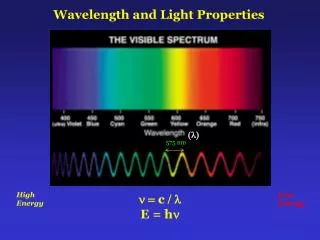
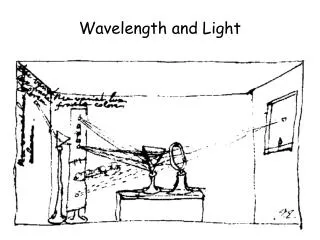
Monochromators measure the power or energy at different wavelengths Nanometers
Cones and Color Matching (Roorda et al.) Cone inner segments have a diameter of roughly 1-2 micron in foveola and much larger in the periphery. Here (foveolar edge) they are about 3-4 microns (330 microns ~ 1 deg)
Color Matching Is An Important Illusion That Is Understood Quantitatively
and matches then matches The Color Matching Experiment Is Linear If matches
Color Matching Experiment Equation Response CIE RGB functions Input SPD
Single Unit Cone Photocurrent Measurements (Schnapf, Baylor et al).
L S M Stimuli Causing Equal Cone Signals Match Perceptually Absorption rate L M S Cone type
Behavioral CMFs are accurately predicted by cone responsivities
Blue Sky Direct Sun Illumination And Color Appearance Are Closely Coupled Through Color Constancy