Exploring Polyhedra and Cross-Sections in Geometry
This homework assignment focuses on Euler's Theorem and its application in determining the number of edges in a figure with 6 vertices and 4 faces. Students will also identify non-polyhedral figures and analyze the properties (faces, edges, vertices) of various geometric shapes, including cylinders, prisms, tetrahedrons, and spheres. Additionally, they will make educated guesses about the cross-sections formed when these shapes are intersected by a plane. Engagement with these concepts enhances understanding of geometric relationships and properties.

Exploring Polyhedra and Cross-Sections in Geometry
E N D
Presentation Transcript
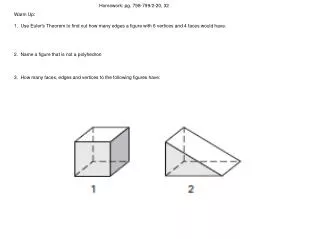
Homework: pg. 798-799/2-20, 32 Warm Up: 1. Use Euler's Theorem to find out how many edges a figure with 6 vertices and 4 faces would have. 2. Name a figure that is not a polyhedron 3. How many faces, edges and vertices to the following figures have:
right cylinder rectangular prism tetrahedron sphere Homework: pg. 798-799/2-20, 32 cube triangular prism square pyramid triangular prism pentagonal pyramid cone
Make a guess about what shape you would fill in each blank (There may be more than one right answer!): A sphere is intersected by a plane. The cross section is a ________________________________.
A cone is intersected by a plane. The cross section is a __________________________________.
A cylinder is intersected by a plane. The cross section is a ____________________________.
A cube is intersected by a plane. The cross section is a __________________________________.
Attachments words1.docx