Genetic Disorders
590 likes | 712 Vues
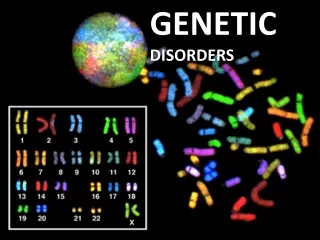
This comprehensive overview provides a clear understanding of genetic disorders, detailing definitions and key concepts such as chromosomes, genes, alleles, genotypes, and phenotypes. It explains the variations in gene expression (dominant and recessive), the significance of euploidy, aneuploidy, and polyploidy, and various types of genetic mutations including chromosomal and gene mutations. The text also addresses congenital disorders, their classifications, and the mechanisms behind chromosomal abnormalities and their impacts, including common syndromes like Down's and Turner’s syndrome.

Genetic Disorders
E N D
Presentation Transcript
INTRODUCTION:DEFINITION OF TERMS • CHROMOSOMES- cellular structures where genes are located • GENES- basic units of heredity carry information necessary to determine specific biologic structures & functions • ex. ABO Ag in RBC membrane coded by chromosome 9 • LOCUS- position in the chr where particular gene is located; all gene loci occur in pairs except X & Y genes
INTRODUCTION:DEFINITION OF TERMS • ALLELES- alternative genes in a single locus • ex. Kell blood group system • alleles K & k • KK- homozygous Kk- heterozygous • HOMOZYGOUS GENES- gene pair that are alike • HETEROZYGOUS GENES- gene pair that are not alike • GENOTYPE- actual gene composition that make the trait • PHENOTYPE- manifestation of the structure/ form produced by the genes
INTRODUCTION:DEFINITION OF TERMS • DOMINANT GENES- genes that are always expressed in the phenotype whether homozygous or heterozygous • RECESSIVE (AMORPH) GENES- genes that are masked if paired w/ a dominant gene, thereby only expressed when paired w/ another recessive gene
INTRODUCTION:DEFINITION OF TERMS • EUPLOIDY- multiples of the haploid # that is considered normal • HAPLOID (N)= 23- OCCURS IN MEIOSIS • DIPLOID (2N)= 46- OCCURS IN MITOSIS • ANEUPLOID- not exact multiples of the haploid #; only 1 pair of chr involved, therefore, germ cells have 2 copies of the same chr or lack the affected chr entirely • HYPODIPLOID 2N- 1, -2, ETC. (MONOSOMY) • HYPERDIPLOID 2N+ 1, +2, ETC. (TRISOMY)
INTRODUCTION:DEFINITION OF TERMS • POLYPLOID- multiples of haploid #; entire set of chrs fail to divide & all the chrs are segregated in a single daughter cell • TRIPLOID (3N)= 69 • TETRAPLOID (4N)= 92
Congenital Disorders • Non Genetic: • Developmental defects – Malformations • Genetic Disorders • Chromosomal • Gene - Mendelian • Multifactorial
Mutations: • Genome: whole set – Polyploidy 4n, 8n etc. • Chromosomal: change in chromosome • Number: Trisomy, monosomy • Structure: Deletion, Translocation etc. • Gene: Submicroscopic • Point mutation – single base sequence • Deletions • Insertions
Cytogenetic Abnormalities: • Abnormal # of chrs: • Non-disjunction - Down’s Syndrome • Anaphase lag - Turner’s xxx • Abnormal Structure: (normal #) • Deletion - 5q- Cri - du - chat syndrome • Inversion - • Translocation - Ph Chromosome - t(9:22) CML,
GENETIC PATHOLOGY: • DEFINITION: Abnormalities or disease states that may or may not be congenital, transmitted by genes or chromosomal aberrations, that may be heritable (familial) or mutational • If mutational, may give the following outcomes: • Heritable • Disappear • Lethal • Sterility • Malignancy
CATEGORIES: • CHROMOSOMAL ABNORMALITIES/ MUTATIONS • GENE ABNORMALITIES/ MUTATIONS • POLYGENIC/ MULTIFACTORIAL ABNORMALITIES
I. CHROMOSOMAL ABNORMALITIES/ MUTATIONS GENERAL CONCEPTS: • Children born to older women show more chromosomal aberrations than children born to younger women • Most major chromosomal abnormalities are incompatible w/ life • Detectable by karyotyping (chromosomal analysis) w/ or w/o banding techniques (use of stains)
I. CHROMOSOMAL ABNORMALITIES/ MUTATIONS::: TYPES: • NONDISJUNCTION (Chromosomal numerical aberration)- failure of chrs to sort themselves in equal #s into daughter cells • SUBTYPES: • POLYPLOIDY- see previous definition • ANEUPLOIDY- see previous definition • MOSSAICISM/ MYXOPLOIDY
I. ANEUPLOIDY: TRISOMY • TRISOMY- presence of 3 homologous chromosome in a cell • AUTOSOMAL TRISOMY- viable throughout pregnancy, even live born but die soon after birth except Down's syndrome • TRISOMY 21- DOWN'S SYNDROME • TRISOMY 18- EDWARD'S SYNDROME • TRISOMY 13- PATAU'S SYNDROME
I. ANEUPLOIDY: TRISOMY • SEX CHR. TRISOMY- abnormal development but non lethal; # of X chr. is directly proportional to mental retardation while number of Y chr. is directly proportional to aggressive behavior • TRIPLE X
I. ANEUPLOIDY: MONOSOMY • MONOSOMY- absence of one of a pair of homologous chr • AUTOSOMAL MONOSOMY- IUFD is the usual outcome • SEX CHR. MONOSOMY- compatible w/ life only if the conserved chr is an X, if not it will be less viable • TURNER'S SYNDROME- 45, XO
I. ANEUPLOIDY: MOSSAICISM/ MYXOPLOIDY • MOSSAICISM/ MYXOPLOIDY- nondisjunction at a later cell division resulting to population of normal & trisomic or monosomic cells coexisting in an individual • AUTOSOMAL MOSSAICISM- rare & lethal • SEX CHR. MOSSAICISM- common • GONADAL DYSGENESIS- TURNER'S SYNDROME 45, XO • KLINEFELTER'S SYNDROME 47 XXY
I. CHROMOSOMAL ABNORMALITIES/ MUTATIONS::: TYPES: I. MORPHOLOGIC/ STRUCTURAL SUBTYPES: • DELETION- loss of chromosomal material following a break in the chr arm or partial monosomy • CRI DU CHAT- partial monosomy of p5 • RETINOBLASTOMA- q13 • WILM'S TUMOR ANIRIDIA SYNDROME- p11
I. MORPHOLOGIC/ STRUCTURAL SUBTYPES: • TRANSLOCATION- transfer of segment of chromosomal material to another chromosome leading to imbalance of material in each daughter cell between non homologous chr • RECIPROCAL- acentric segments of chr exchanged for similar segment from a heterologous chr; use banding techniques for detection • ROBERTSONIAN (CENTRIC FUSION)- 2 acrocentric chr broken near centromere, exchange 2 arms and form new large metacentric chr and a small fragment, devoid of centromere & lost during subsequent division
I. MORPHOLOGIC/ STRUCTURAL SUBTYPES: • TRANSLOCATION • BALANCED- transfer w/ no loss of genetic material; individuals are normal except for infertility & if fertile, have a high risk of having malformed offspring • UNBALANCED- transmitted in the haploid gamete & paired w/ a new set of genes from the other parent • MALIGNANT LYMPHOMA- between 8 & 14 • LEUKEMIAS- between 22 & 9 • DOWN'S SYNDROME- chr 21
I. MORPHOLOGIC/ STRUCTURAL SUBTYPES: • TRANSLOCATION • ISOCHROMOSOMAL- faulty division of centromere at the transverse plane of the long axis w/ formation of a pair of isochromosome (one short arm & one long arm) • TURNER'S SYNDROME
I. MORPHOLOGIC/ STRUCTURAL SUBTYPES: • INVERSION- break of a chr at 2 points, followed by inversion of the intermediate segments & reunion results in the formation of a chr w/ rearranged distribution of genes • PERICENTRIC- rotation occurs around the centromere • PARACENTRIC- rotation occurs only on the acentric portion of the arm
I. MORPHOLOGIC/ STRUCTURAL SUBTYPES: • RING CHROMOSOME- break in the telomeric ends of the chr followed by deletion of the broken acentric segments & end to end fusion of the remaining portion
II. GENE ABNORMALITIES/ MUTATIONS GENERAL CONCEPTS: • Single gene defect detectable in the phenotype • Modified by penetrance, expressivity & whether defect is dominant, intermediate, recessive or X linked • Dominant pattern of inheritance usually due to alteration of aa sequence in the gene • Recessive pattern of inheritance (inborn errors of metabolism) usually is due to manufacture of abnormal enzymes or enzyme deficiencies • Follows Mendelian patterns of inheritance
PATTERNS OF INHERITANCE: AUTOSOMAL DOMINANT • Autosome- gene location • Gene expression- both homozygous & heterozygous state • Transmission of traits in every generation unless Low penetrance or modified by gene mutations • Unaffected family members do not transmit trait to offspring; affected family members usually heterozygous & transmit trait to only half of the offspring • M = F
PATTERNS OF INHERITANCE: AUTOSOMAL DOMINANT • Pp x pp • Pp : Pp : pp : pp • DIABETIS INSIPIDUS • MUSCULAR DYSTROPHY • POLYDACTYLISM • MARFAN'S SYNDROME • ACHONDROPLASTIC DWARFISM • HUNTINGTON'S CHOREA • GARDNER'S SYNDROME • GOUT • HEMOCHROMATOSIS
PATTERNS OF INHERITANCE: AUTOSOMAL RECESSIVE • Autosome- gene location • Gene expression only in the homozygous state • Both parents usually heterozygous for the trait & clinically unaffected • Symptoms appear in 25% of offspring • 50% of all siblings will be heterozygous for the trait thus assymptomatic • M = F
Nn x Nn NN : Nn : Nn : nn ANDROGENITAL SYNDROME ALBINISM ALKAPTONURIA DEAF MUTISM GALACTOSEMIA PHENYLKETONURIA FAMILIAL GOITROUS CRETINISM CYSTIC FIBROSIS GLYCOGEN STORAGE DISEASES MUCOPOLYSACCHARIDOSIS LIPID STORAGE DISEASE WILSON'S DISEASE TYROSINOSIS BILIRUBIN METABOLIC ABNORMALITIES PATTERNS OF INHERITANCE: AUTOSOMAL RECESSIVE
PATTERNS OF INHERITANCE: X LINKED RECESSIVE • X chromosome - Gene location • Expression of traits • 100% heterozygous male • Rare homozygous female • Partial heterozygous female if X Chromosome inactivation occurs • Transmission via asymptomatic female • Each son of heterozygous female carrier has 1 in 2 chances of having the disease • Affected males do not transmit trait to their sons, only to their daughters; Unaffected males do not transmit the gene
FEMALE X MALE (HEMOPHILIAC) XX x Xh Y XXh : XY : XXh : XY FEMALE (CARRIER) x MALE (NORMAL) Xh X x XY Xh X : Xh Y : XX : XY HEMOPHILIC COLOR BLINDNESS G6 PD DEFICIENCY MUSCULAR DYSTROPHY- DUCHENNE TYPE PATTERNS OF INHERITANCE: X LINKED RECESSIVE
PATTERNS OF INHERITANCE: X LINKED DOMINANT • Rare • Affected heterozygous female transmit to 50% sons & 50% daughters • Affected males transmit to 100% daughters & none to their sons • VIT. D RESISTANT RICKETS
PATTERNS OF INHERITANCE: Y LINKED • Not clinically significant • Hairy ears
III. POLYGENIC/ MULTIFACTORIAL ABNORMALITIES GENERAL CONCEPTS: • Environmentally influenced interactions of a number of different gene pairs • HYPERTENSION • DIABETIS MELLITUS • PEPTIC ULCER • OTHER CONGENITAL HEART DISEASES
CHROMOSOMAL DISEASES:SEX CHROMOSOMAL ABNORMALITIES • X DEFICIENCY • TURNER'S SYNDROME 45, XO • Short stature female w/ webbed neck, cubitus valgus, immature genitalia w/ small fibrotic (streak) ovaries, coarctation of aorta; mostly abort; no Barr Bodies; almost 50% are mossaics w/ less stigmata • ULLRICH NOONAN SYNDROME (46, XX or XY ::: 46, X(Xq) • Turner like phenotype; often w/ pulmonary stenosis; giant Barr Bodies
CHROMOSOMAL DISEASES:SEX CHROMOSOMAL ABNORMALITIES • KLINEFELTER'S SYNDROME 47, XXY • Most common of X chromosomal abnormality • Tall eunuchoid male w/ gynecomastia, small testis w/o spermatogenesis (infertile) • Mossaics occur
CHROMOSOMAL DISEASES:SEX CHROMOSOMAL ABNORMALITIES • MISCELLANEOUS SYNDROMES • TRIPLE X (47 XXX)- mildly retarded; normal female phenotype • 47 XYY- tall, aggressive, mildly retarded male; increased incidence among criminal
CHROMOSOMAL DISEASES:SEX CHROMOSOMAL ABNORMALITIES • INTERSEX STATES- HERMAPHRODITISM • TRUE HERMAPHRODITE- XX or XY or both; variable phenotype, both ovaries & testis are present • PSEUDOHERMAPHRODITES (NORMAL GENECITY) • Male phenotypically female; testicular feminization • Female phenotypically male; virilizing ovarian or adrenal tumors
CHROMOSOMAL DISEASES: AUTOSOMAL ABNORMALITIES • More severe effects than X chr anomalies • Monosomies more severe than trisomies • The larger chromosome involved, the more serious the phenotypic disorder
CHROMOSOMAL DISEASES: AUTOSOMAL ABNORMALITIES • DOWN'S SYNDROME- TRISOMY 21, MONGOLISM; 47 G21+ • Most common of the trisomies; maternal risks increases w/ age; incidence equal in both sexes; usually due to maternal nondisjunction • Floppy infants w/ psychomotor retardation, mongoloid facies, epicanthic folds, flat nose, cardiovascular anomalies, simian palm creases, cryptorchidism, increased incidence of leukemia • Variant - Translocation type (heritable)- occurs at any maternal age; 46 XY -D; +tDqGq
Downs Syndrome - Trisomy-21 Simian Crease
Downs Syndrome: • Mental retardation • Neck folds • Epicanthic folds • Flat facial profile • Simian crease • Hypotonia • Umbilical hernia • Leukemia
CHROMOSOMAL DISEASES: AUTOSOMAL ABNORMALITIES • EDWARD'S SYNDROME (16 - 18 TRISOMY, E TRISOMY); 47, E18+ • Female predilection; low set ears, epicanthic folds, micrognathia, CVS anomalies, overlapping 2nd & 5th finger, rocker bottom feet, renal anomalies, early death • PATAU'S SYNDROME (13 - 15 TRISOMY, D TRISOMY); 47, D13+ • Least common, both sexes equally affected; low set ears, micropthalmia, brain anomalies, cleft lip & palate, overlapping 2nd & 5th finger, CVS anomalies, rocker bottom feet
CHROMOSOMAL DISEASES: AUTOSOMAL ABNORMALITIES • CRI DU CHAT SYNDROME, 5p- • Rare, common in females, cat cry, moon faced, retarded, micrognathia, antimongoloid slant, CVS anomalies • D13p-, D13q-, E18q-, TRIPLOIDY • Severe anomalies, lethal • PHILADELPHIA CHROMOSOME, G22q- • Associated w/ CML; good prognosis