Download
1 / 46
470 likes | 611 Vues
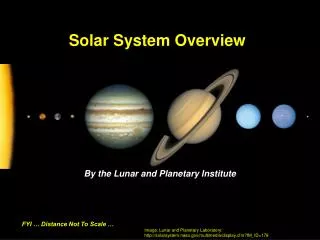
The Solar System, dominated by the Sun, contains various celestial bodies, including eight major planets categorized into terrestrial and Jovian types. The inner planets—Mercury, Venus, Earth, and Mars—are rocky and smaller, while the outer planets—Jupiter, Saturn, Uranus, and Neptune—are gas giants with thick atmospheres. Pluto, now classified as a dwarf planet, showcases unique features that differentiate it from others. Understanding orbital mechanics, gravity, and the environments of celestial bodies deepens our knowledge of these fascinating worlds.

E N D
17-1: What is the Solar System • The Sun contains 99.85% of all the matter in the Solar System. • The planets revolve around the Sun in orbits • Most planets orbit the sun in a counter-clockwise fashion
Nebula spinning cloud of gas and dust in space • One theory to explain how the solar system formed is a nebula • http://www.picturethecosmos.com/
Inner Planets: Small Rocky Worlds • Terrestrial Planets – are small, dense, rocky worlds with less atmosphere than the other type of planet. • They have craters, no rings, very few moons, very small. • Mercury • Venus • Earth • Mars
Outer Planets: Gas Giants • Jovian Planets – are large, gaseous, low density worlds. Thick gaseous mostly hydrogen atmospheres, rings, lots of moons, and very large in comparison to terrestrial planets. • Jupiter • Saturn • Neptune • Uranus
Pluto • Pluto – doesn’t fit either category. Pluto is a small icy world clearly different from either the Jovian and Terrestrial worlds.
Sun’s Family • Sun’s family consists of 8 planets, > 162 moons, & at least 3 dwarf planets
17-2 Orbits • Gravity force of attraction btw 2 objects with mass • Gravity keeps the planets in orbits flying around the Sun • All planets travel in elliptical orbits • Planets travel fastest at perihelion (closest to Sun) & slower at aphelion (farthest from Sun
17-3 Our Moon • American landed on the Moon on July 20,1969 • The Moon’s gravity is 1/6 that of Earth • The Moon has no liquid water • Temp. ranges from 100°C to below -200°C (100°C is boiling)
17-3 Features of Our Moon • Maria smooth, dark areas on the Moon that are broad, flat plains; maria means “seas” • Light areas that are mountains or highlands; some are higher than on Earth • Craters caused by large objects striking the surface or erupting volcanoes
17-4 Other Moons • Satellite an object that orbits another body in space • Moons are natural satellites • All planets except Mercury & Venus have 1 or more moons
Moons of the Inner Planets • Mercury has 0 moons • Venus has 0 moons • Earth has 1 moon • Mars has 2 moons; Deimos & Phobos
Moons of the Outer Planets • Jupiter has at least 63 moons; Ganymede,Callisto, Io, & Europa are the 4 largest • Saturn has 59 moons; Titan is the largest • Uranus has 27 moons; Titania & Oberon are the largest • Neptune has 13 moons; Triton & Nereid are visible
17-5 Mercury • Mercury closest planet to the Sun • Dry • Rocky • No atmosphere • Temp. ranges from 430°C to -170°C • Covered with craters
17-5 Venus • Venus similar to Earth in size, mass, & density Very hostile environment Highest temp. of all planets 90 times more air pressure than Earth Carbon dioxide atmosphere & clouds of sulfuric acid cause a runaway Greenhouse Effect Retrograde rotation (east to west) Has smooth plains, mountains, valleys
17-5 Earth • Third planet from Sun • Only planet with oceans of liquid water • Only planet with life because it has moderate temp., liquid water, & atmosphere w/ O2
17-6 Mars • Fourth planet from Sun • Orbit period687 days; rotation24 hr. 37 min. • ½ diameter of Earth • Has volcanoes, polar icecaps, craters, river channels • Thin CO2 atmosphere • No visible water
17-6 Mars cont. • Cold, dry world; colder than Antarctica in winter, as warm as the Midwest in spring • Winds up to 100 km/h cause dust storms • Volcanoes bigger than Earth Mars has less gravity • Canyon bigger than U.S.
17-7 Asteroids & Meteoroids • Asteroid belt btw. Mars & Jupiter • Asteroids leftover debris from the formation of solar system that orbit the Sun • Pieces of rock and metal
17-7 cont. • Meteoroids small chunks of asteroids that travel in space • Meteor rock or metal that enters a planet’s atmosphere • Meteorite rock that hits a planet’s surface
17-8 Jupiter • Largest planet • 5th planet from Sun and 1st gas giant • Made up mostly of Hydrogen and Helium • Has faint rings of ice and dust • Best known feature is Great Red Spot raging hurricane
17-8 Saturn • 2nd largest planet • 6th planet from Sun & 2nd gas giant • Made mostly of Hydrogen & Helium • Least dense of all planets; would float in water • Best known for its rings
17-9 Uranus • 3rd largest planet • 7th planet from Sun & 3rd gas giant • Made mostly of Hydrogen and Helium • Atmosphere contains methane • Appears to lie on its side • Has faint rings
17-9 Neptune • 4th largest planet • 8th from Sun & last gas giant • Made mostly of Hydrogen & Helium • Upper atmosphere is methane • Has Great Dark Spot similar to Jupiter’s Great Red Spot • Winds blow east to west @1500 km/h
17-9 Dwarf Planets • In 2006 Pluto was reclassified as a dwarf planet • Dwarf planet small, planetlike object that orbit the Sun, but share their orbits with other objects • Pluto, Ceres, Eris
17-9 Kuiper Belt • Kuiper belt is btw Neptune & outer regions of solar system • 100 million fragments of ice & rock • Includes dwarf planets & their moons
17-10 Comets • Comet lump of ice, frozen gas, & dust • Orbit the Sun in long, ellipses that go beyond Pluto • Has 3 parts: • Nucleus dirty ice ball • Coma cloud of gas surrounds • Tail(s) melting particles that point away from the Sun
17-10 Comets cont. • Comets come from the Oort Cloud • Far beyond Neptune’s orbit • May contain trillions of inactive comets