Continental Drift
Continental drift is the geological theory that Earth's continents were once joined as a single landmass known as Pangaea, which began to break apart about 200 million years ago. Alfred Wegener proposed this hypothesis, supported by fossil evidence, such as the Mesosaurus found in both South America and western Africa. Climate evidence shows ancient tropical plants in Greenland, while geologic evidence aligns rock layers in Brazil with those in western Africa and the Appalachian Mountains. Explore the compelling proof of continental drift and its impact on Earth's history.


Continental Drift
E N D
Presentation Transcript
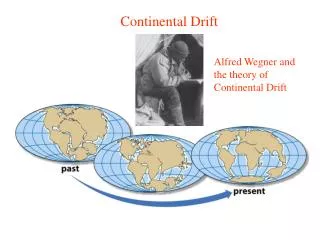
What is it? • Continental Drift - Earth’s continents were once joined in a single landmass, and gradually moved, or drifted apart. • People thought this for centuries - they began thinking this when the first maps were introduced to the world. • Alfred Wegener came up with the hypothesis of continental drift.
Fossil Evidence • The same fossils have been discovered in South America as well as in western Africa. • Mesosaurus - a reptile that lived in ancient time • Lived 270 million years ago • Fossils are only found in these two places
Climate Evidence • Today, Greenland lies near the north pole. • There are fossils being dug up in Greenland that have ancient tropical plants. • How did tropical plants get to an area that is so cold and covered in ice? • South Africa is warm today? • South Africa has evidence that it was once covered by ice.
Geologic Evidence • The kinds of rocks on each continent can be matched to another continent. • The rock layers in Brazil match the rock layers in western Africa. • Rocks in the Appalachian Mountains match rocks found in Scotland.
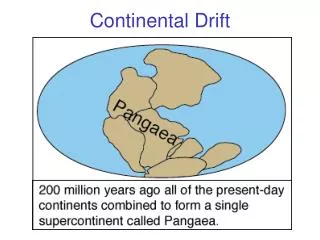
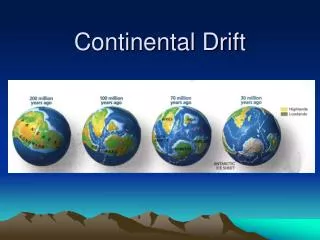
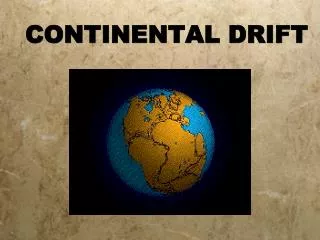
Pangaea • With so much evidence that the continents were once connected, Wegener drew a conclusion. • The continents all were connected in a supercontinent that was named Pangaea. • Pangaea split apart 200 million years ago.