Evolution via natural selection
This piece explores the fundamental principles of evolution via natural selection, emphasizing the necessity of individual variation, heritable traits, and differential fitness within populations. It poses intriguing hypothetical scenarios that question how evolution would be affected if all organisms shared the same size or traits. Additionally, the document delves into the characteristics of key animal phyla, including Echinodermata and Chordata, outlining their unique features and significance in the tree of life.

Evolution via natural selection
E N D
Presentation Transcript
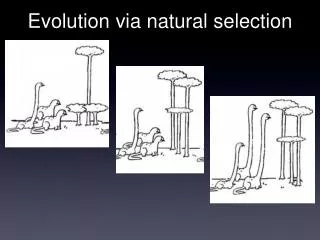
What would happen if all of the trees and dinosaurs were the same size?
Individual variation is necessary for natural selection to occur
What would happen if all the dinosaurs produced just one offspring?
Differential fitness is necessary for natural selection to occur
What would happen if offspring never resembled their parents? Parents: ✖ Offspring:
Traits must be heritable for natural selection to occur ✖ Parents: Offspring:
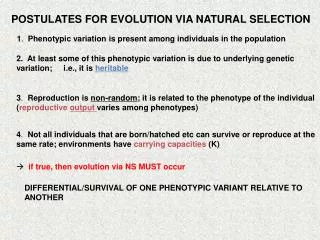
Conditions required for natural selection to occur: Individual variation:members of a species differ in their characteristics Mode of inheritance:parents pass on some of their traits to their offspring Differential fitness: some individuals leave more offspring than others due to their special inherited traits
Change in population occurs because of differences in reproductive success. Organisms do not evolve because they want or need to change.
Animal Diversity 2 • Deuterostomes: Echinodermata and Chordata
Echinodermata “Spiny skin” • Endoskeleton of spiny plates • Marine animals (no freshwater or terrestrial species) • Adults = radial; larvae = bilateral • Water vascular system (used for feeding, gas exchange, and locomotion) • Canals end in “tube feet”; opening = madreporite
Chordata • Pharyngeal slits/pouches • Dorsal nerve cord • Notochord • Post-anal tail
Dorsal (hollow) nerve cord Nerve cord Notochord
Nerve cord Notochord Notochord Flexible rod that supports the nerve cord (becomes intervertebral discs in between vertebrae in humans.)
Chordata • Pharyngeal slits • Dorsal nerve cord • Notochord • Post-anal tail
Subphyla Cephalochordata Urochordata (tunicates) Vertebrata
Cephalochordata Example: lancelets