
The Scientific Method
E N D
Presentation Transcript
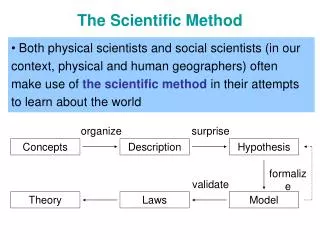
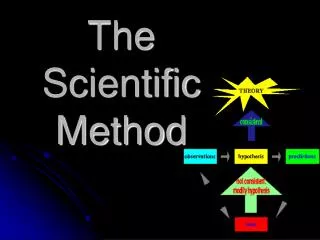
Steps of the Scientific Method • The Scientific Method is used by all Scientists • The Scientific Method is made up of many parts called “steps” • The Scientific Method can be described as having anywhere from 5-8 steps which are sometimes given different names
Steps of the Scientific Method • Remember these 6 steps: • Identify the Problem • Collect Information • Form a Hypothesis • Design and Carry Out an Experiment • Analyze Data • Draw Conclusions
STEP 1: Identify the Problem • What problem needs to be solved? • What question needs to be answered? • The PROBLEM is always stated in the form of a question. • Example: Which type of soda will help radish seeds grow best?
STEP 2: Collect Information • Your textbook or other resources can provide you with information before you make a hypothesis • Example: Look on the back of the radish seed packet to get information, look online to find what type of growing conditions radishes prefer, or buy a gardening book
STEP 3: Form a Hypothesis • Use your prior knowledge and any new information you have collected • A HYPOTHESIS is a prediction or statement that can be tested • Example: IF radish seeds are grown in Hawaiian Punch, THEN they will grow tallest.
STEP 4: Design and Carry Out Experiment • Variables are what are tested in an experiment (dependent & independent) • Only one variable is changed at a time. • Independent Variable: the variable that is changed. AKA-manipulated variable; X-axis • Example: The type of liquid (diet coke, sprite, etc.) • Dependent Variable: the factor being measured. AKA-responding variable; Y-axis • Example: The height of the radish plant.
STEP 4: Design and Carry Out Experiment (continued) • Constants: the variables that stay the same • Example: same amount of liquid, same amount of light, same number of seeds, etc. • Control: a sample that is treated exactly like the other experimental groups except that the independent variable is not applied to it • It is under normal conditions • Example: The radish plant given water
STEP 4: Design and Carry Out Experiment (continued) • Number of Trials: to make sure that you are getting valid results, you will need to repeat the experiment several times
STEP 5: Analyze Data • Organizedata by putting it into graphs, tables, and charts
STEP 6: Draw Conclusions • Does your data support your hypothesis? • If the data supports the hypothesis, repeat the experiment to verify. • If the data does not support the hypothesis, change your hypothesis and try again. • Why did you get these results? • What might have happened that could affect your results?
STEP 6: Draw Conclusions • REMEMBER - There are no wrong hypothesis! • There are only results that don’t support your hypothesis • Sample Conclusion: Hawaiian Punch is the best liquid for radish growth