Download
1 / 30
320 likes | 460 Vues
Explore the fascinating history of photography, starting with the Camera Obscura, which laid the groundwork for capturing and processing images. Discover the contributions of pioneering figures such as Joseph Nicéphore Niépce, who experimented with light-sensitive chemicals, and William Henry Fox Talbot, who perfected the Calotype process. Learn about Louis Daguerre’s revolutionary Daguerreotype and Frederick Scott Archer’s introduction of the Collodion process. This journey through time highlights how photography evolved from a scientific curiosity into a powerful medium for documenting history and shaping public opinion.

E N D
Two vital element in Photography Question#1 • Optical: Lenses captures light • Chemicals: Allowed photographers to process their negatives and prints
Camera Obscura Question# 2 • Latin for dark room. • People using this technology. • Aristotle (c. 300 BC). • Leonardo da Vinci (1452-1519). The camera obscura(Lat.dark chamber) • Arabian scholar Hassan ibn Hassan in the 10th century • Later another device that will aid in drawing will be developed in the 1800’s call the Camera Lucida
Camera Obscura • Optical device used in drawing, • Contributed toward the invention of photography. • Photographic devices today are still known as "cameras".
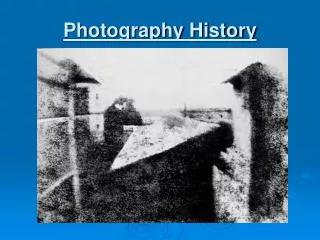
Joseph Nicéphore Niépce • 1816-1818, experiments combining Camera Obscura with light-sensitive paper, failures • Found that Silver Nitrate and Silver Chloride would turn black when struck by light. • 1818, image fixed for 3 months • He ran out of money and in poor health. • He stopped short of producing a permanent image.
William Henry Fox Talbot Question#3 • Title: William Henry Fox Talbot. (1800-1877) • In England, Talbot creates permanent (negative) images using paper soaked in silver chloride and fixed with a salt solution. • Perfected the Calotype process
Calotype Process • photogenic drawing • First to produce a negative image. • not as bright or as detailed as daguerreotype • multiple copies could be made • Image quality is a little soft and unsharp
Louis JacquesMande Daguerre (pronounced Dagair) • Title: Louis Jacques Mande Daguerre. (1787-1851) • dioramas (Diorama) • interest in lenses • 1829: after several years of back and forth, Niépce and Daguerre team up. • 1833: Niépce dies, penniless. • Daguerre first to make a positive image as mercury vapor was used to produce an image formed on a silver coated copper sheet made sensitive to light • Question # 4
Daguerreotype Process • Mirrorlike surface, negative from certain angles delicate, in thick glass • No multiple prints • Could not capture motion • 5-40 minute exposure time • Initially, not practical for portraits
Early Photography Question #5 • Early Photography consisted mostly of pictures of Famous People and Out Doors
Frederick Scott Archer Collodion (wet plate) process Question#6 • Frederick Scott Archer invents Collodion process (but doesn’t patent)
Collodion Process • This process replaces Daguerrotype • The definite advantage was that the collodion plate had a depth of detail and sharpness unprecedented exposed and developed inside the camera. • reduced exposure time to just a few seconds • brought portraiture to the people (tintype)
REVIEW • People just covered • DaVinci - lenses • Niepce - chemical • Talbot - Calotype process • Daguerre - Daguerreotype process • Morse - most famous Daguerrotypist • Archer - Collodion process • Process just covered • Calotype – perfected by Talbot • Daguerretype – developed by Daguerre • Collodion – developed by Archer
Matthew Brady Question #7 • Title: Mathew Brady, 1875 • taught by Samuel Morse • had portrait studios in New York and Washington DC • portrait photographers’ pictures of soldiers • 1862, closed studios, went to photograph the Civil War
Matthew Brady • Title: First Battle of Bull Run, 1861 • was probably one of the greatest of photographic documentary photographers • by end of Civil War, his team had taken over 7000 negatives • didn’t ignore harsh reality • public wasn’t ready for stark brutality of images
Darkroom of the Civil War Question #8 • The Civil War Darkroom was a Covered Wagon • Very mobile • Used by • Brady • Gardner • O’Sullivan • W.H. Jackson
Photography more than a portrait Question # 9 - William Henry Jackson photographed the frontier http://www.andrewsmithgallery.com/exhibitions/whjackson/index.htm • Yellowstone Park • Helped to create Yellowstone as a park once viewed by Congress Yellowstone Park
What was just covered • Photography came out of the studio • Real life pictures were documenting current events • Photography persuades public opinion
Joseph Muybridge • 1871 Invention of the moveable shutter • Had a bet with Leyland Stanford that a horse in full stride did not have all four feet off the ground. • In 1878 Muybridge proved the horse bunched the legs under it belly at full stride. • The techniques eventually lead to motion pictures.
Horse Running Question # 10 • Click here to see horse video.
George Eastman Question # 11 • Title: A 1954 U.S. stamp featuring George Eastman. 1888 • Photo paper could be purchased instead of made by hand. • $25 camera. $10 have photos developed.
Kodak #1 camera, Question # 12 • Photo taken with Kodak #1 camera, 1890 • Took 100 photos • The entire camera was sent back to Kodak for developing • By the end of the century camera clubs were flourishing
What we just covered • Photography was capable caputuring multiple images • Kodak put cameras in the hands of common people • “Snapshot” clubs developed
Alfred Stieglits Question # 13 • Top: self-portrait of Alfred Stieglits • Bottom: everyday life • Stieglits produced emotional glimpses of everyday life. • “Documentary” Photography born • Champion of • “Straight Photography”
Photo as a means of expression Question # 14 • Light meter invented 1930 • Half-tone process created and used in the mass production of books and magazines • History has now become visual as well as verbal. Question # 15 • Life Magazine is the birth of “Photojournalism”. • Vogue Magazine used the camera as a platform for fashion.
What we just covered • Everyday life is photographed • Documentary photography is developed • The light meter was developed • Mass production of photos is capable due to the half-tone process • Life and Vogue magazine have photos as their magazine foundation.
Ansel Adams Question # 16 • Title: • Ansel Adams, • El Capitan, Winter • Ansel Adams and Fred Archer are credited with creating the zone system • Adams is primarily associated with Yosemite Valley, Ca. imagery.
Diane Arbus Question # 17 • She took her camera places where people we afraid to go. • Mental hospitals • Physical deformities
The Big Picture of Photography • Expression of art as well as science • Portraits - Talbot • Document history – Brady • Motion pictures developed out of photography - Horse • Kodak put the camera in the hands of all - Eastman • Everyday life documented - Stieglitz • Books/Magazines used photography for their products/beliefs - Life/Vogue • Landscape was explored – Ansel Adams • The physical surroundings were invistigated both human and natural – Diane Arbus