Muscular system
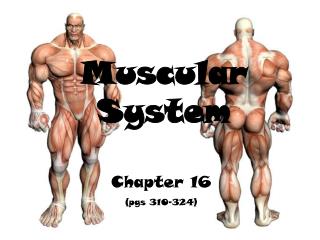
The muscular system is essential for body movement, posture maintenance, and heat generation. It consists of three muscle types: smooth (involuntary), skeletal (voluntary), and cardiac (involuntary). Smooth muscles line the digestive system and blood vessels, while skeletal muscles control movements of the limbs and body positions. Cardiac muscles are unique to the heart. Muscles often work in pairs (e.g., biceps and triceps) to facilitate movement. Learn about muscle functions, types, and their automatic and voluntary control in this informative overview. Watch the video at [YouTube](http://www.youtube.com/watch?v=au1ucKBcjfU) for more insights.

Muscular system
E N D
Presentation Transcript
Muscular system by: Riley Hamilton
Muscle movement • Involuntary- Automatically move without you knowing. • Voluntary- Brain sends message to muscle. You control the movements.
Types of muscles • Smooth- involuntary • Skeletal- voluntary • Cardiac- involuntary
Smooth muscles • Involuntary • Lines digestive system • Lines blood vessels • Contracts bladder • Movements involve many muscles at a time
Skeletal muscles • Under voluntary control • Moves arms, legs, head • Allows us to change body position • Produces most of body heat
Cardiac muscles • Found only in heart • Striated like skeletal muscle • Involuntary • Pushes blood out of the heart
Muscle terms • Flexion- Movement that reduces a joint angle. • Extension- A movement that increases a joint angle.
Muscle pairs • Your muscles work in teams to move your body. An example of this is your Bicep and Tricep.
Muscular system video • http://www.youtube.com/watch?v=au1ucKBcjfU
Function of the muscular system • The muscular system is the series of muscles throughout the body that moves the skeleton, maintains posture through steady contraction, and generates heat through cell metabolism.
Works cited • Images: • http://www.google.com/imgres?imgurl=&imgrefurl=http%3A%2F%2Fhealthfavo.com%2Fhuman-muscular-system-for-kids.html&h=0&w=0&tbnid=k_g8BaKRJCIoTM&zoom=1&tbnh=230&tbnw=219&docid=6zZxoBp8XCDdyM&tbm=isch&ei=HtowU-X9Ee-g0gHN64HIBg&ved=0CAIQsCUoAA • http://www.google.com/imgres?imgurl=&imgrefurl=http%3A%2F%2Fwww.rci.rutgers.edu%2F~uzwiak%2FAnatPhys%2FCardiovascular_System.html&h=0&w=0&tbnid=SWqb4d6jX3pSUM&zoom=1&tbnh=194&tbnw=259&docid=LHAQAMC8GOflKM&tbm=isch&ei=UNswU_nLLuqd0AHrkYAY&ved=0CAUQsCUoAQ