

SlideServe
Menu
Préférences
© SlideServe · v2026

Odds are:

ruby-hartman avatar
7 diapositives · 167 Views · Oct 26, 2014

Learn how odds represent probability in favor or against an event. Discover examples and formulas to calculate odds and probabilities. Explore practical applications with practice questions.
Odds are: - slide 1
01 / 7Odds are:
1 / 17

Télécharger la présentation

Odds are:
Une image / un lien ci-dessous est fourni (tel quel) pour télécharger la présentation

Politique de téléchargement : le contenu du site vous est fourni TEL QUEL pour votre information et votre usage personnel ; il ne peut être vendu, concédé sous licence ni partagé sur d’autres sites sans l’accord de son auteur.Le contenu vous est fourni TEL QUEL, pour votre information et votre usage personnel uniquement. Téléchargez la présentation en cliquant sur ce lien. Lors du téléchargement, si vous ne parvenez pas à télécharger une présentation, l’éditeur a peut-être supprimé le fichier de son serveur.Pendant le téléchargement, si vous ne parvenez pas à obtenir une présentation, le fichier a peut-être été supprimé par l’éditeur.

F I N

Plus de contenu associé

Transcription de la présentation
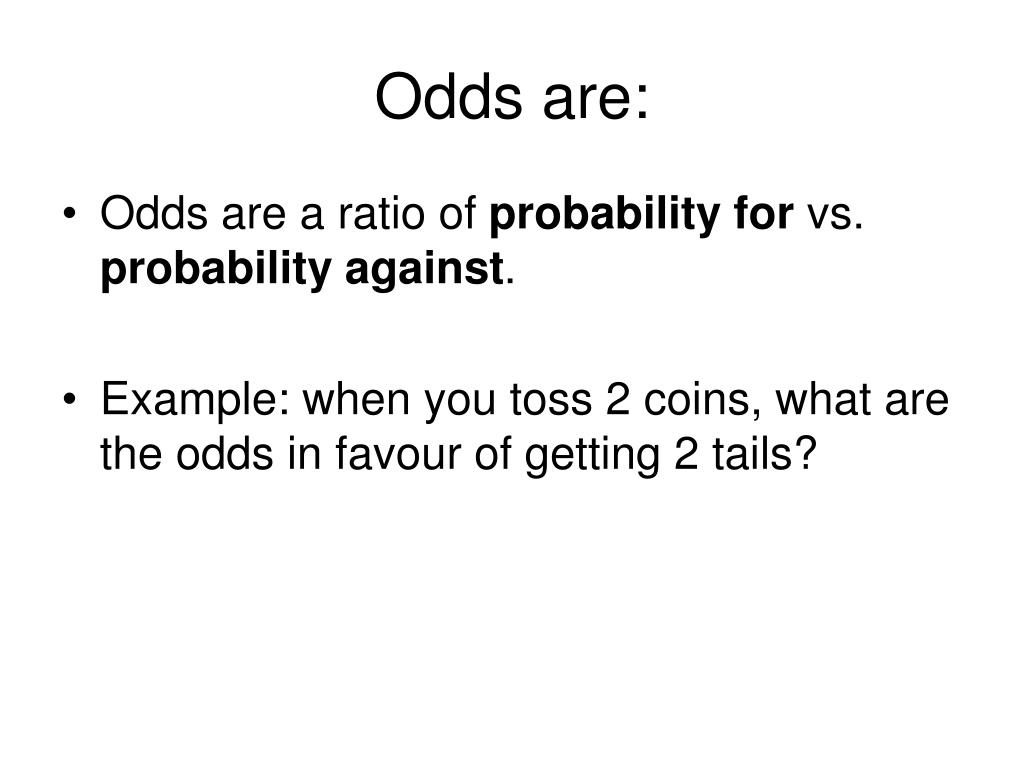
  1. Odds are: • Odds are a ratio of probability for vs. probability against. • Example: when you toss 2 coins, what are the odds in favour of getting 2 tails?

  2. Example: when you toss 2 coins, what are the odds in favour of getting 2 tails? • Coin 1 Coin 2 P(2 tails)=1/4 P(2 tails’)=3/4 Odds in favour of 2 tails: ¼ : ¾ 1:3 Notice, there is 1 way to get 2 tails and 3 equally likely ways of NOT getting 2 tails. H H T H T T

  3. Odds against • The odds against getting 2 tails is simply • P(2 tails’):P(2 tails) 3:1 Notice that the numbers have simply switched places from our Odds For ratio.

  4. The odds for it raining tomorrow are 5:3What is the probability of rain?

  5. The odds for it raining tomorrow are 5:3What is the probability of rain?

  6. In General (so you don’t need to re-solve the last equation every time) • If the Odds For event A are x:y • P(A)= • This should remind you of potential divider circuits where the ratio of output to input voltage is • What do you think P(A’) is?

  7. Practice • Page 318 questions 1 to 12