Comparative Evaluation of Therapeutic Strategies in Stable Angina Patients
Study compares the efficacy of medical therapy, PCI, and CABG in patients with stable angina, preserved LVF, and MVD over a 10-year follow-up. Results show CABG and PCI offer benefits over MT in clinical endpoints, with similar mortality rates.

Comparative Evaluation of Therapeutic Strategies in Stable Angina Patients
E N D
Presentation Transcript
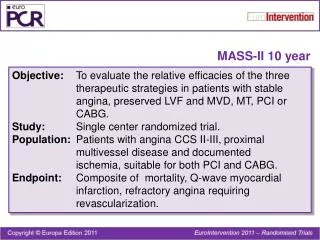
MASS-II 10 year Objective: To evaluate the relative efficacies of the three therapeutic strategies in patients with stable angina, preserved LVF and MVD, MT, PCI or CABG. Study: Singlecenter randomized trial. Population: Patients with angina CCS II-III, proximal multivesseldisease and documented ischemia, suitable for both PCI and CABG. Endpoint: Composite of mortality, Q-wave myocardial infarction, refractory angina requiring revascularization.
Medical therapy n=203 Patients randomized n=611 90% LAD disease 41% 2 vessel 58 % 3 vessel PCI n=205 CABG n=203 MASS-II 10 year
MASS-II 10 year Event rate at f-up (%) p=0.089 p=0.01 p =0.001 p<0.001 p < 0.001 HR foroccurrence of compositeend-point (Cox regression): CABG vs MT: 0.43 (0.32-0.56) p=0.001 CABG vs PCI: 0.54 (0.4-0.72) p=0.001 MT vs PCI: 1.27 (0.99-1.62) p=0.06
MASS-II 10 year Conclusion: At 10 year follow-up the MASS II trial showed the benefits of CABG and PCI over MT with regard to several clinical end-points, although with similar rates of overall mortality. CABG was associated with a higher rate of event free survival. Hueb et al. Circulation 2010;122:949-57