Understanding the Six Kingdoms of Life: Vocabulary and Characteristics
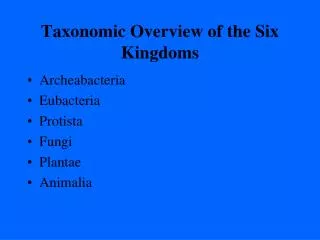
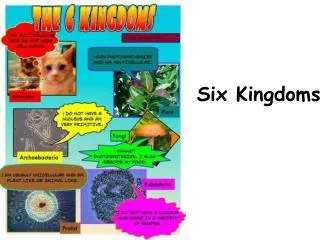
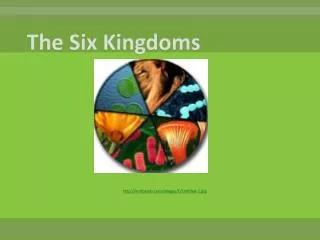
This overview provides essential vocabulary and information about the Six Kingdoms of life: Archaebacteria, Eubacteria, Protista, Fungi, Plantae, and Animalia. It explains key terms such as unicellular and multicellular organisms, autotrophs and heterotrophs, and the differences between prokaryotic and eukaryotic cells. Explore the various organisms within each kingdom, their habitats, nutritional modes, and unique characteristics, such as Eubacteria's role in decomposition, and the extreme environments inhabited by Archaebacteria.


Understanding the Six Kingdoms of Life: Vocabulary and Characteristics
E N D
Presentation Transcript
Vocabulary Which term means one-celled? Many-celled? • multicellular • unicellular Which term means that the organism produces its own food? Consumes food? • autotroph • heterotroph
Vocabulary • Prokaryotic – describes an organism with cells that have a cell membrane but do NOT have a nuclear membrane • Eukaryotic – describes an organism with cells that have a cell membrane and a nuclear membrane
Vocabulary • Autotrophic – makes its own food • Heterotrophic – gets nutrients from the food it consumes
List of the Three Domains and the Six Kingdoms 1.Domain Bacteria • Kingdom Eubacteria 2. Domain Archaea • Kingdom Archaebacteria 3. Domain Eukarya • Kingdom Protista • Kingdom Fungi • Kingdom Plantae • Kingdom Animalia
Kingdom Eubacteria • Bacteria can live in many places on earth, inhabiting a wide variety of habitats, including other organisms • Unicellular • Prokaryotic • Autotrophic or heterotrophic • Thick cells walls with peptidoglycan
Kingdom Eubacteria • Bacteria come in different shapes, such as round, spiral and rod-shaped.
Kingdom Eubacteria • Bacteria can cause a wide variety of diseases, such as strep throat, food poisoning and the Black Death (bubonic plague of the Middle Ages)
Kingdom Eubacteria • Bacteria also play an important role in decomposition, nitrogen fixation and human digestion (E. coli) Soybean root containing billions of bacteria
Kingdom Eubacteria • Procholorococcus – an autotrophic bacterium – What does that mean about how it gets its nutrients?
Kingdom Eubacteria • Bacteria from an Nitrifying Trickle Filter (NTF) stained with acridene orange. The stain makes DNA appear yellow and RNA appear orange.
Kingdom Archaebacteria • Bacteria that live in extreme habitats, such as hot springs, geysers, volcanic hot pools, brine pools, black smokers • Unicellular • Prokaryotic • Autotrophic or heterotrophic • Cell walls without peptidoglycan
Kingdom Archaebacteria Morning Glory Pool in Yellowstone National Park – note the bright colors from the archaebacteria growing in the extremely hot water.
Kingdom Archaebacteria • Some like it hot! Bacillus infernus
Kingdom Archaebacteria • Archaebacteria can live deep in the ocean near geothermal vents called black smokers • There is no light, so they carry out chemosynthesis instead of photosynthesis
Kingdom Protista • Extremely diverse group • Eukaryotic • Most unicellular, some colonial, some multicellular • Autotrophic and heterotrophic • Some with cell walls containing cellulose; some carry out photosynthesis with chloroplasts
Kingdom Protista Euglena - autotrophic Volvox – a colonial protist A slime mold Amoeba - heterotrophic
Kingdom Fungi • Eukaryotic • Most are multicellular • Heterotrophic (decomposers) • Cell walls made of chitin
Kingdom Fungi Stilton cheese Bread mold
Kingdom Plantae • Eukaryotic • Multicellular • Autotrophic • Cell wall of cellulose; chloroplasts present
Kingdom Animalia • Eukaryotic • Multicellular • Heterotrophic • No cell walls, no chloroplasts
Kingdom Animalia Flatworm Sponge Jellyfish Octopus Coral snake Bear