Self-Oscillating Converters
130 likes | 254 Vues
This document by Andrew Gonzales provides an in-depth look at self-oscillating converters, detailing their general operating principles and circuit operation. Key topics include transformer design, frequency control, and the roles of various transformer windings. It covers critical transformer design steps, including core size selection, primary and feedback winding calculations, and determining core gap using empirical methods and data. Applications range from auxiliary power supplies to off-line power sources, emphasizing advantages such as cost-effectiveness and compact size, along with potential frequency instability issues.


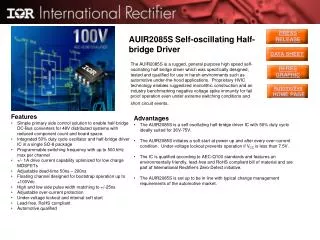
Self-Oscillating Converters
E N D
Presentation Transcript
Self-Oscillating Converters By: Andrew Gonzales EE136
INTRODUCTION • General Operating Principle • How the circuits work • Transformer Design for Converter
General Operating Principle • Switching action • Maintained by positive feedback from a winding on the main transformer. • Frequency • Controlled either by saturation of the main or subsidiary transformer • Controlled by a drive clamping action
Transformer Design (Step 1)Core Size • No fundamental equation linking transformer size to power rating. • Use nomograms provided by manufacturers to pick core size
Transformer Design (Step 2)Primary Turns • Assuming the following parameters: • Frequency = 30 kHz (½ period t = 16.5 s) • Core area Ae 20.1 mm2 • Supply Voltage Vcc 100 V • Flux density swing DB 250 mT • Np = = 330 turns
Transformer Design (Step 3)Feedback and Secondary turns • We want the feedback voltage to be at least 3 V to make sure we have an adequate feed back factor for the fast switching of Q1. Nfb = = 9.9 turns The secondary voltage should be 12.6 V because we want the output voltage to be 12 V and there is a 0.6 V diode loss. Ns = = 42 turns
Transformer Design (Step 4)Primary current • Assuming 70% efficiency and output power of 3 W, our input power should be 4.3 W. Which gives the mean input current at Vcc = 100 V to be Im = = 43 mA • The peak current can be calculated as Ipeak = 4 x Imean = 172 mA • The actual collector current must exceed this calculated mean current by at least 50% to make sure that the diode D2 remains in conduction during the complete flyback period. Ip = 1.5 x Ipeak = 258 mA.
Transformer Design (Step 5)Core Gap • 2 ways to calculate core gap • Empirical method • By Calculation and Published data • Empirical method Use a temporary gap and and operate with a dummy load at the required power. Adjust the gap for the required period.
Transformer Design (Step 5)Core Gap (cont.) • By Calculation and Published Data We first calculate the required inductance of the transformer using the following formula: Lp = = 6.4mH We can then use this value to calculate the AL factor (nH/turn2) AL = = 59 nH/turn
Transformer Design (Step 5)Core gap (cont.) • From the graph we can determine the core gap at AL = 59 nH
Conclusion • Applications • Auxiliary power for larger power converters • Stand-by power source in off line power supplies • Advantages • Low cost, simplicity, and small size • Disadvantages • Frequency instability due to changes in the magnetic properties of the core, load or applied voltage