Advances in D* Particle Tagging at ZEUS: A New Method for Impact Parameter Calculation
140 likes | 270 Vues
This presentation by Philip Allfrey details innovative work on a method developed for tagging D* particles in the ZEUS detector using impact parameters. It highlights critical aspects such as impact parameter calculation, signal improvement through vertex analysis, and the upgrade of the Silicon Micro Vertex Detector (MVD) that enhances tracking near interaction points. The methodology involves reconstructing charmed mesons from decay products and applying significance cuts to optimize D* candidate selection. The implications for future charm production studies are discussed, paving the way for refined analysis techniques.


Advances in D* Particle Tagging at ZEUS: A New Method for Impact Parameter Calculation
E N D
Presentation Transcript
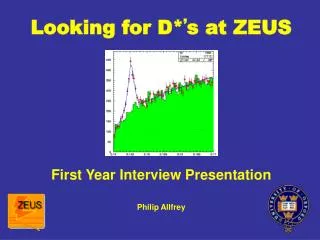
Looking for D*’s at ZEUS First Year Interview Presentation Philip Allfrey
This talk describes work done on a new method for tagging charmed particles at ZEUS 1. Impact Parameter Calculation 2. Finding D*’s 3.Using Impact Parameter to improve D* signal
Primary vertex Secondary vertex The ZEUS detector upgrade should allow tagging of heavy particles from secondary vertices Silicon Micro Vertex Detector (MVD) installed in ZEUS over 2000-1 shutdown Improves tracking close to interaction point Should be able to resolve particles decaying close to primary vertex These particles will have non-zero impact parameter
A method for calculating the impact parameter has been developed Impact Parameter: Signed distance of closest approach of track to primary vertex Numerical method used Primary Vertex Calculate distance from primary vertex to several points on helix Impact Parameter Find point p which gives minimum p Calculate distance for points around p Find minimum and repeat till convergence Track
6 4 2 0 2 4 6 0.6 0.4 0.2 0 0.2 0.4 0.6 Fitting tracks inside the MVD allows impact parameters to be found more precisely With MVD MVD PR No MVD Impact parameter (mm)
A sample of charmed mesons was found for testing impact parameter methods Long term: Tag charm production via impact parameter or secondary vertices First steps: Reconstruct charmed mesons from decay products Apply cuts on significance of tracks to see if improves signal Specifically: Choose decay mode D* → D0 ps→ (Kp) ps Use existing D* algorithm (MVD only for pattern recognition) Apply standard cuts on pT, h of tracks
450 400 350 300 250 200 150 100 50 0 0.14 0.17 0.145 0.15 0.155 0.16 0.165 D*’s were reconstructed from the Kppdecay mode D* candidates M(Kpp) – M(Kp) (GeV)
200 175 150 125 100 75 50 25 0.14 0 0.17 0.145 0.15 0.155 0.16 0.165 Background is reduced with a higher pT cut D* candidates M(Kpp) – M(Kp) (GeV)
Impact parameter Significance: Error 300 250 200 150 100 50 0 -4 -3 -2 -1 0 1 2 3 4 Significance cuts were applied to D* candidates Gives less weight to poorly determined tracks If secondary vertices, expect excess of +ve significance Try cut: Signif. of K, p > x, signif of ps < x Reduces total numbers Doesn’t improve signal Significance for K in D* peak
Multiple scattering may significantly affect impact parameter of ps p ps ps has a momentum cut pT > 0.12 GeV p, K have momentum cut pT > 0.4 GeV Impact parameter and error distributions significantly broader for ps 0 0.5 1.5 1.0 2.0 Impact Parameter Error (cm) May be due to multiple scattering(ps “too slow” ) p ps Cutting on imp. par. or significance of ps may not be a good idea -2 -1 0 1 2 Impact Parameter (cm)
All the steps need to be completed before drawing conclusions Using MVD tracking Using MVD pattern recognition only Write Code Impact parameter calculation Write Code + alignment corrections Apply impact parameter cuts Find D* sample Draw Conclusions
Summary Method for calculating impact parameter developed D* signal found First impact parameter cuts tried Future Plans Use MVD tracks for all steps Refine impact parameter cuts Tag charm production directly
Impact parameter cuts were applied to D* candidates ps comes from D* decay, i.e. (essentially) from primary vertex → zero impact parameter K, p come from D0 decay, i.e. secondary vertex → non-zero impact parameter Try cut: IP of ps less than IP’s of K and p Only reduces total numbers by 90%
r-z r-Φ [ Takanori Kohno ] Resolution Includes both errors from hit reconstruction and track parameters.