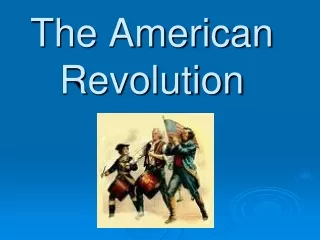
The American Revolution
320 likes | 420 Vues
The American Revolution marked a pivotal moment in history, as the thirteen colonies united against British tyranny in their pursuit of independence. The Suffolk Resolves in September 1774 urged colonists to resist new laws, with influential leaders like both Adamses, Washington, and Patrick Henry rallying support for liberty. The Continental Congress emerged as a platform for organized resistance, which led to vital moments like the battles of Lexington and Concord. Ultimately, the Declaration of Independence proclaimed unalienable rights and paved the way for a new nation dedicated to liberty, democracy, and individual freedoms.


The American Revolution
E N D
Presentation Transcript
The American Revolution The Coming Of Independence
Suffolk Resolves • Sept. 1774 MA • Don’t obey new laws • w/hold taxes • Prepare for war
Continental Congress • Sept. 1774 – Philadelphia • Organize resistance to Intolerable Acts • 12 colonies (GA didn’t go) • Most prominent leaders • MA both Adamses • VA (7) Washington, Lee, Henry
Patrick Henry • “I am not a Virginian, but an American.” • “Give me liberty, or give me death!”
Continental Association • Endorsed Suffolk Resolves • Almost complete halt of trade w/ GB • Encouraged domestic manufacturing • Authorized Committees of Safety
Committees of Safety • Take action against “enemies of American Liberty” • Businessmen seek to profit from scarcity • Chance for lower classes to get involved in politics. • Younger people determined not to let resistance drop. • Cause of Boston the cause of colonies
Liberty • 1775 - “Americans are liberty mad” • Right to resist oppressive authority. • Liberty was the cause of God • Rights of Englishmen & natural rights & universal freedom • Locke’s theory of natural rights.
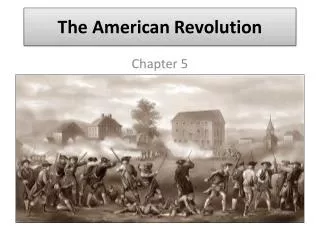
Outbreak of War • Apr. 19, 1775 • Lexington & Concord • 49 Am. 73 Brit. • Word spread through colonies
May 1775 - Ethan Allen & Green Mtn. Boys • Capture Ft. Ticonderoga
Siege of Boston • June 17 – Battle of Bunker Hill (costly Brit victory) • Winter ’75 H. Knox has cannon dragged 100 miles to Boston. • March 1776 Brit. Gen. Howe abandoned city.
Second Continental Congress • May 1775 • Raise an army • Print $ • Geo. Washington commander • Experienced • Southerner • Reinforce unity • GB declares colonies state of rebellion.
Independence? • 1775 many shied away. • Some colonies feared anarchy from below as much as tyranny from above. • Effected how leaders thought about ind. • MA & VA support • So. Wanted power & angered by Dunmore Proclamation. • NY & PA more difficult
Common Sense • July 1775 Olive Branch Petition rejected. • 1776 Thomas Paine writes pamphlet justifying independence.
Audience • Unique – directed to uneducated • Clear, direct, uncomplicated • Expanded those who were now in the debate • Sold more than 150,000 copies • $ went to supply troops
Alternative • Attacked Brit. system (King & Elite rule) • Better alternative • Democratic system • Frequent election • Peoples rights protected by constitution
Independence • “A continent should not ne ruled by an island” • Leaving empire, free to trade w/ world • Free from England’s wars • Empire a burden not a benefit
New Vision • “The cause of America is the cause of all mankind.” • New nation home of freedom. • “an asylum for mankind”
Result • By Spring of 1776 people are ready • Communities passing resolutions calling for separation. • Only 6 mo. Passed from Common Sense and Declaration of Ind.
Activity 1 • Who makes the rules in your home? • Who makes the decisions? • What decisions do you make? • Is there anything you would want to change about the rules or decision-making process in your family?
Activity 2 • Who provides the basic needs of your family? • Describe the breakdown of chores at home. What do you do? • Who decided how these chores would be divided? • Do you get an allowance or any payment for what you do?
How would you set up a home? • Think of all the economic and household responsibilities that you would now assume? • Think of new problems that might arise from living in a group and how they might get solved.
Closing Thoughts • What are the benefits of living at home? Of living on one’s own? • Were you surprised at how many responsibilities independence gave you?
The Declaration of Independence • July 2, 1776 United States formed • July 4 - D of I signed • Written by T. Jefferson • List of grievances “absolute tyranny” • Condemned king for slavery • Deleted by congress (GA & SC)
The Preamble • “unalienable rights” • Basic, rooted in human nature itself • No gov’t could take away • The right of revolution • “the consent of the governed” • Social contract (Locke) • “to alter or to abolish it”
Legacy • Inspiration for those denied natural rights. • Inspire colonial people around world seeking independence & self-gov’t.
New Definition of Freedom • Shift from rights of Englishmen to rights of mankind. • Liberty no longer a privilege, now a universal entitlement.
“pursuit of happiness” • Open-ended democratic process • develop own potential • Self-fulfillment unimpeded by gov’t • A central part of American freedom. • Americans will shape their society as they saw fit.
An Asylum For Mankind • “American exceptionalism” • US has a special mission • Refuge from tyranny • Symbol of freedom • Model for the world • Central to American nationalism
“workshop of liberty to the Civilized World” • J. Madison • “we have it in our power to begin the world over again” – T. Paine • Revolution of global historical importance.