Balanced Chemical Equations for Chemical Reactions
Learn how to balance chemical equations and understand reactants and products in chemical reactions step by step. Get helpful hints and examples.

Balanced Chemical Equations for Chemical Reactions
E N D
Presentation Transcript
Chemical Reaction • A chemical reaction is the process by which atoms of one or more substances are rearranged to form different substances.
Reactant(s) • Reactant(s) are the starting substance(s) of a reaction • Reactant(s) are on the left
Product(s) • Product(s) are the substance(s) formed during the reaction • Product(s) are on the right
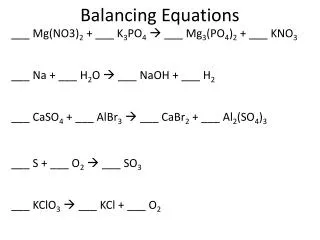
Balanced Chemical Equation • The equation that shows the number of atoms of each reactant and each product is equal on both sides of the arrow is a balanced chemical equation • Example 2Fe(s) + 3Cl2(g) 2FeCl3(s) Reactants Products
Step 1 • List the atoms present for the reactants • List the atoms present for the products • List in this order: • metals • non-metals • hydrogen • oxygen last **Make sure both lists are in the same order! met a non hairy oxen?
Step 2 • Total atoms on the reactant side • Total atoms on the product side **Combine like atoms on the same side of the reaction
Step 3 • Balance an element by placing a coefficient in front of the chemical formula **Select coefficients that will give the same number of atoms on each side of the equation.
Step 4 • Adjust atom totals for all atoms affected by the addition of your coefficient **Other elements may have become unbalanced.
Step 5 • Continue to add coefficients and make adjustments until all elements are balanced
Helpful Hints • If you have an odd number of oxygen atoms, multiply the coefficient by 2 first to make it an even number. Then try to balance the equation. • If you end up with an odd total of a diatomic element, try doubling all coefficients in the reaction to balance out the diatomic.