20 Years of Research on Peer Services in Mental Health: Findings and Implications
This comprehensive review examines two decades of peer-related research in mental health services. Analyzing 126 studies, 48 were identified as both methodologically sound and relevant. Key findings reveal that peer providers can deliver comparable outcomes to traditional professionals. Peer services enhance engagement and retention, particularly when integrated into existing programs. Regular attendance in peer groups is associated with improved outcomes, while specific services like Vet to Vet demonstrate notable benefits. This synthesis highlights the growing importance of peer support in mental health care.

20 Years of Research on Peer Services in Mental Health: Findings and Implications
E N D
Presentation Transcript
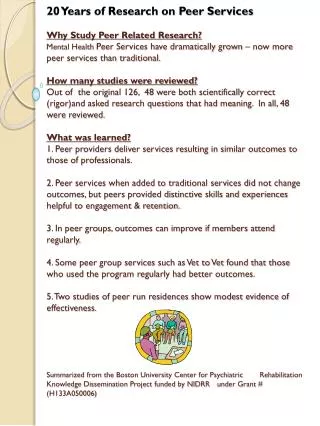
20 Years of Research on Peer ServicesWhy Study Peer Related Research?Mental Health Peer Services have dramatically grown – now more peer services than traditional.How many studies were reviewed?Out of the original 126, 48 were both scientifically correct (rigor)and asked research questions that had meaning. In all, 48 were reviewed.What was learned? 1. Peer providers deliver services resulting in similar outcomes to those of professionals.2. Peer services when added to traditional services did not change outcomes, but peers provided distinctive skills and experiences helpful to engagement & retention.3. In peer groups, outcomes can improve if members attend regularly.4. Some peer group services such as Vet to Vet found that those who used the program regularly had better outcomes.5. Two studies of peer run residences show modest evidence of effectiveness.Summarized from the Boston University Center for Psychiatric Rehabilitation Knowledge Dissemination Project funded by NIDRR under Grant # (H133A050006)