Understanding PCR: Principles and Troubleshooting Techniques
70 likes | 266 Vues
This workshop provides an in-depth exploration of the Polymerase Chain Reaction (PCR), including its fundamental principles and practical applications. Participants will learn about the exponential amplification phase of PCR, the significance of reagent concentration, and critical troubleshooting tips to optimize results. Websites and resources for further reading are included to enhance understanding. Key concepts such as DNA electrophoresis and quantification methods will also be discussed.


Understanding PCR: Principles and Troubleshooting Techniques
E N D
Presentation Transcript
Principles of PCR MUPGRET Workshop June 20, 2006
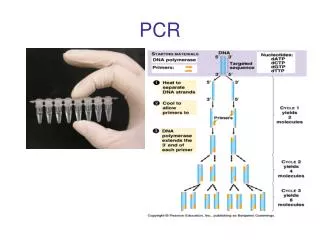
PCR • Polymerase Chain Reaction • http://www.dnai.org/b/index.html • http://palou.uib.es/roolpi/PCR/
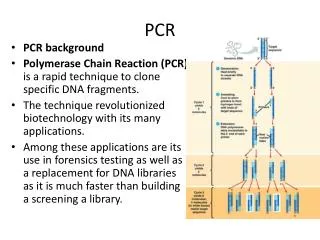
Basic PCR • Initially reagents in excess, template and product don’t renature and outcompete primer binding, so amplification occurs at an exponential rate. • Timepoint when exponential turns to linear rate is different depending on the initial concentration of the target molecule.
Basic PCR • To properly quantify one product relative to another you need to be in the exponential phase of amplification for both and know when the end point occurs.
Troubleshooting PCR • http://www.promega.com/guides/pcr_guide/070_22/promega.html • http://info.med.yale.edu/genetics/ward/tavi/Trblesht.html • http://palou.uib.es/roolpi/PCR/
Electrophoresis • A way to separate DNA molecules. • http://gslc.genetics.utah.edu/units/biotech/gel/