The Evolution of Progressivism: Government Reforms and Theodore Roosevelt's Legacy
This article explores the key elements of Progressivism in American politics, focusing on significant reforms aimed at reducing corruption and enhancing voter connection. It examines Theodore Roosevelt’s role as a reformer and the tensions between his vision and the Republican Party. The piece covers major legislation like the Pure Food and Drug Act and the establishment of the National Park System while discussing the outcomes of the 1908 and 1912 elections, including the rise of the Progressive Party and the impact of Woodrow Wilson's New Freedom.

The Evolution of Progressivism: Government Reforms and Theodore Roosevelt's Legacy
E N D
Presentation Transcript
Government Reforms • Fighting corruption • Making government more connected to the voters • Bringing professional to politics (city mangers) • Initiative (Populists) • Referendum (Populists) • Direct primary • Recall
Robert La Follette • Gov. of Wisconsin • “Laboratory of Progressivism”
Theodore Roosevelt • Myth – progressive reformer • Reality – more of a conservative interested in expanding presidential power • Not willing to be controlled by the Republican Party • Moderate
TR & the Role of the Government • Mediator • More of a trust regulator than a “trust buster” • Department of Commerce & Labor • Sherman Anti-Trust Act • Northern Securities Company (1904) • Arbitration of Strikes • United Mine Workers (1902)
The Square Deal • Hepburn Railroad Regulation • Pure Food and Drug Act • Meat Inspection Act • Proposed – 8hr work day • “a chicken in every pot”
Conservation • Government land in the West • Gifford Pinchot • National Forest Service • Newlands Act (dams, reservoirs, and canals in the West)
Preservation • National Park System • Created Yellowstone National Park
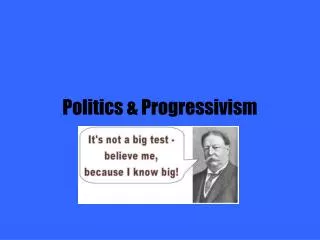
Election of 1908 • TR takes a few on the chin • Panic of 1907 • “the promise of 1904” • Too radical?
Election of 1908 • A reluctant TR • Taft’s wife issues • Taft – choice of the Party • TR’s choice • A SAD VICTORY
Taft – Failed Compromise • Tried to pick the middle road b/t progressives & conservatives and made no one happy • TR felt betrayed by Taft and became publically critical
Election of 1912 • Nasty primaries for the Republicans • The Old Guard gave the nomination to Taft • Democrats – Wilson • The Progressive Party – TR (aka Bull Moose Party) • The third party ensured the victory for the DEMOCRATS!
Wilson’s New Freedom • Progressive – after the trusts • Expanded presidential power • Federal Reserve Act – reform of the banking system – more flexible and reliable system of supplying banks & the nation with paper money • Some changes BUT derailed by World War I and a stroke