ACIDS AND BASES
This guide explores the properties of acids and bases, highlighting their distinct characteristics such as taste, solubility, and conductivity. Acids, known for their sour taste, react with metals and release hydrogen ions (H+), while bases are characterized by a bitter taste and the release of hydroxide ions (OH-). The pH scale, ranging from 0 to 14, distinguishes between acids (pH < 7) and bases (pH > 7), with neutral solutions having a pH of 7. The role of indicators, such as litmus paper, in identifying acids and bases through color change is also discussed.

ACIDS AND BASES
E N D
Presentation Transcript
Properties of ACIDS • associated with a sour taste • water soluble • react with metals to produce hydrogen gas • good conductors of electricity • associated with H+ • strong acids can be dangerous
Properties of BASES • associated with a bitter taste • opposite of acids • release OH- when dissolved in water • feels slippery in solution • good conductor of electricity • will neutralize acids • associated with OH- • strong bases can be dangerous
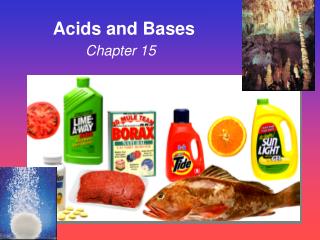
Look at the following list. Make a chart and state whether the item is an acid or a base (some are weak and some are strong!)
THE pH SCALE • Indicators such as litmus don’t tell us how acidic or how basic a solution is. • We can express the difference between a strong acid and a weak acid or a strong base and a weak base by using pH. • “p” stands for portenz (Danish for strength) • “H” stands for hydrogen ion • The pH scale goes from 0 – 14
The pH scale • When pH is less than 7 it is an ACID • When pH is greater than 7 it is a BASE • When pH is = to 7 it is NEUTRAL
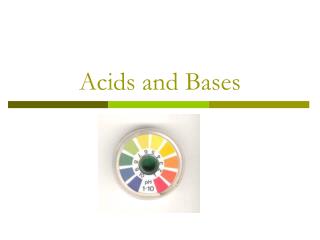
pH paper is paper soaked in Universal indicator and dried. The paper changes colour and then the colour produced is compared to the standard chart provided.
INDICATORS • How do we tell if something is an acid or a base? • Since it is not usually safe to taste if something is sour or bitter scientists have developed indicators. • An INDICATOR is a substance that reacts with an acid or a base to show a definite colour change.
LITMUS PAPER • Litmus is a dye obtained from a special plant • This dye is put into pieces of paper • There are two kinds of litmus paper: • red litmus and blue litmus
Copy down the following chart and watch the demos to see the colour changes that occur to acids and bases with the various indicators.