Download
1 / 24
250 likes | 412 Vues
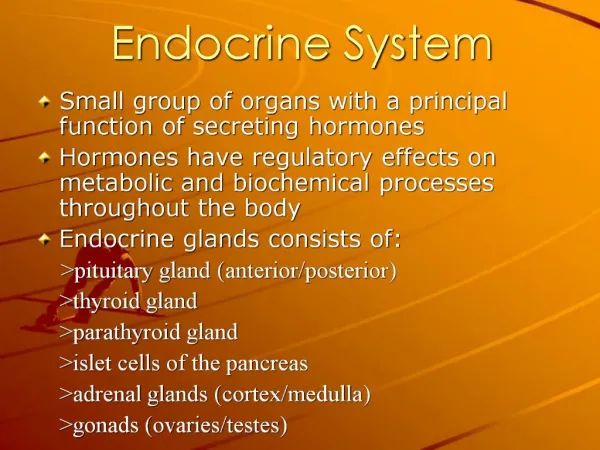
The endocrine system is a complex network of glands responsible for producing hormones that regulate vital bodily functions. Unlike exocrine glands that secrete substances outside the body, endocrine glands release hormones directly into the bloodstream. This system works alongside the nervous system to maintain homeostasis, influencing metabolism, growth, reproduction, and behavior. Hormones can act on specific target cells and produce varied effects, depending on their structure and nature. Understanding the classes of hormones—steroids, peptides, and amines—is essential for grasping their functions and interactions.

E N D
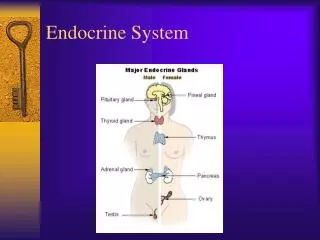
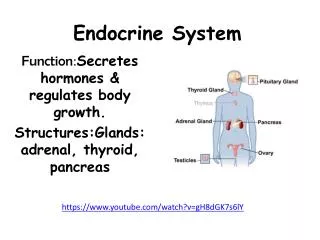
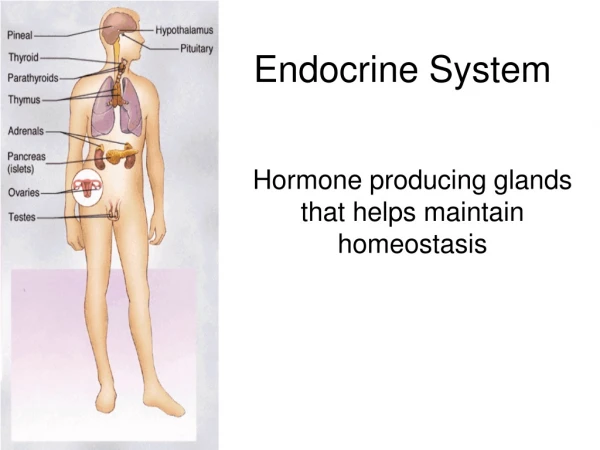
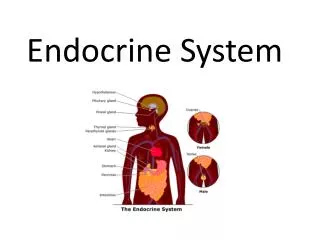
Overview • Body system that consists of a group of glands that produces regulatory chemicals called hormones, and along with the nervous system, controls and coordinates all other systems of the body • Exocrine glands are not part of endocrine sys. –secrete prod.’s that are passed outside body (i.e. salivary, digestive, sweat,…) • Endocrine-ductless, exocrine-ducts
Nervous system vs. Endocrine system • Nervous sys. coordinates rapid activity &precise response • by means of electrical stim. (action potentials) and chemical stim. (neurotransmitters) • Neurotransmitters travel across a narrow space (synaptic cleft), binds to receptors on target cell and act locally to control nerve cell functions. • Endocrine system effects occur slower & over longer period of time • Involve chemical stimuli only (hormones) • Hormones are chemical messenger released by glands or specialized cells into circulating blood and influence the function of cells at another location in the body. (target cells)
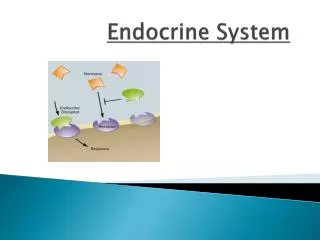
Target cells • Hormones act by binding to receptor sites on target cell, producing a response by the target cell
Target Cell Response • Attached to the cell, the hormone affects cell activities: • Regulating the manufacture of proteins • Changing permeability of the membrane • Affecting metabolic reactions
Hormone Function • Play key role in regulating almost all body functions, including: • Metabolism • Growth & development • Water and electrolytes • Reproduction • Behavior
Generalized Specific Other hormones only affect specific target tissues Examples: ACTH Ovarian hormones • Some hormones affect many diff types of cells of the body • Examples: • GH • Thyroxin • Insulin
Antagonistic Pairs • Some hormones come in antagonistic pairs that have opposite affects on target organs • Ex. Insulin and glucagon
Classes of Hormones • Hormones are grouped into three classes based on structure • Steroids • Peptides • Amines
Steroids • Lipids • Chem. Structure sim. to cholesterol • In most instances synthesized from cholesterol itself • Consist of 3 cyclohexyl rings and one cyclopentyl ring • Very little hormone storage in steroid producing endocrine cells • Large stores of cholesterol esters in cytoplasm vacuoles can be rapidly mobilized for steroid synthesis after a stimulus • Secreted by the adrenal cortex: • Cortisol • Aldosterone • Secreted by ovaries: • Estrogen • Progesterone • Secreted by testes: • Testosterone • Secreted from Placenta: • Estrogen • Progesterone
Peptides, Polypeptides, & Proteins • Short chains of Amino Acids • Most hormones are polypep.’s and proteins • Range and size from small peptides with 3 AA’s (thyrotropin releasing hormone TRS) to proteins with almost 200 AA’s (GH and prolactin) • Polpypepetides with 100 AA’s or more are called proteins • Fewer than 100 = peptides • They are water soluble • Secreted by pituitary, parathyroid, heart, hypothalamus stomach, liver, kidney and pancreas • Precursor molecules processed by ER and golgi are stored in secretory granules
Amines • Derived from amino acid Tyrosine • Secreted from thyroid and adrenal medulla • Water soluble • Stored as granules in cytoplasm until needed • Ex. Epinephrine (adrenaline)
Mechanism of Action • Endocrine sys. acts by releasing hormones that trigger actions in specific target cells • Receptors selective to one type hormone • Receptors are located on target cell membrane whereas others are in cytoplasm or nucleus • First step of hormone action is to bind to specific receptor on target cell (first messenger) • First messenger triggers 2nd messengers to affect cell’s activity • Binding hormone changes shape of receptor causing the response to the hormone • 2 mechanisms of hormone action on all target cells: non-steroid hormones and steroid hormones
Non-Steroid Hormones • Water soluble • Don’t enter cell but bind to plasma membrane receptors (first messenger) • Generates chem signal (second messenger) inside target cell • Second messenger activates other intracellular chemicals to produce the target cell response • Resulting complex activates an enzyme that catalyzes the synthesis of cyclic AMP (cAMP) from ATP • cAMP activates other enzymes to produce target cell response
Steroid Hormones • Pass through plasma membrane act in a 2 step process • Steroid hormones bind to nuclear membrane receptors or receptors in cytoplasm producing activated hormone-receptor complex • Complex enters nucleus binds with chromatin (DNA) and activates specific genes increasing production of proteins • Act more slowly than peptide hormones
Onset of hormone secretion after stimulus and duration of action of different hormones • Some hormones (i.e. norepinephrine and epi.) are secreted within seconds after glands stimulated and may develop full action within another few seconds or minutes • While other hormones (i.e. thyroxine or GH) may require months for full effect • Each hormone has own characteristic onset and duration of action – each tailored to perform its specific function
Hormone receptors - location • The locations for the different types of hormone receptors are generally: 1. In or on the surface of the cell membrane (protein, peptide and catecholamine hormones) 2. In the cell cytoplasm (steroid hormones) 3. In the cell nucleus (thyroid hormones) • Hormonal receptors are large proteins • Each cell that is to be stimulated usually has 2,000 – 100,000 receptors
Transport of Hormones in the Blood • Water soluble hormones are dissolved in the plasma & transported from their site of synthesis to target tissue • They diffuse out of capillaries into the interstitial fluid & ultimately to target cells • Steroid and thyroid hormones circ. In blood bound to plasma proteins (<10% free in soln) • Protein bound hormones can’t easily diffuse across capillaries to get to target cells • They are inactive until disassociate from plasma proteins
Feedback Control of Hormone Secretion • Although hormone concen. Fluctuate in response to various stimuli, they are closely controlled • In most instances negative feedback mechanisms insure proper level of hormone activity at the target tissue • After stim causes release of hormone conditions or products resulting from hormone action suppress further release • The control variable is not the secretory rate of the hormone, but the degree of activity of the target tissue • Thus when target tissue activity rises to approp. Level than feedback signals to endocrine gland to slow further secretion of hormone • Promotes balance and homeostasis
(this is the last slide ) • In a few instances positive feedback occurs when action of hormone causes additional secretion of the hormone • i.e. LH luteinizing hormone • Also periodic variations in hormone release that are influenced by seasonal changes, stages of development and aging, diurnal cycle, and sleep • i.e. GH • Periodic variations due to changes in activity of neural pathways involved in controlling hormone release