
SlideServe
Menu
Préférences
© SlideServe · v2026

Case Study # 2

said avatar
8 diapositives · 384 Views · Sep 19, 2014

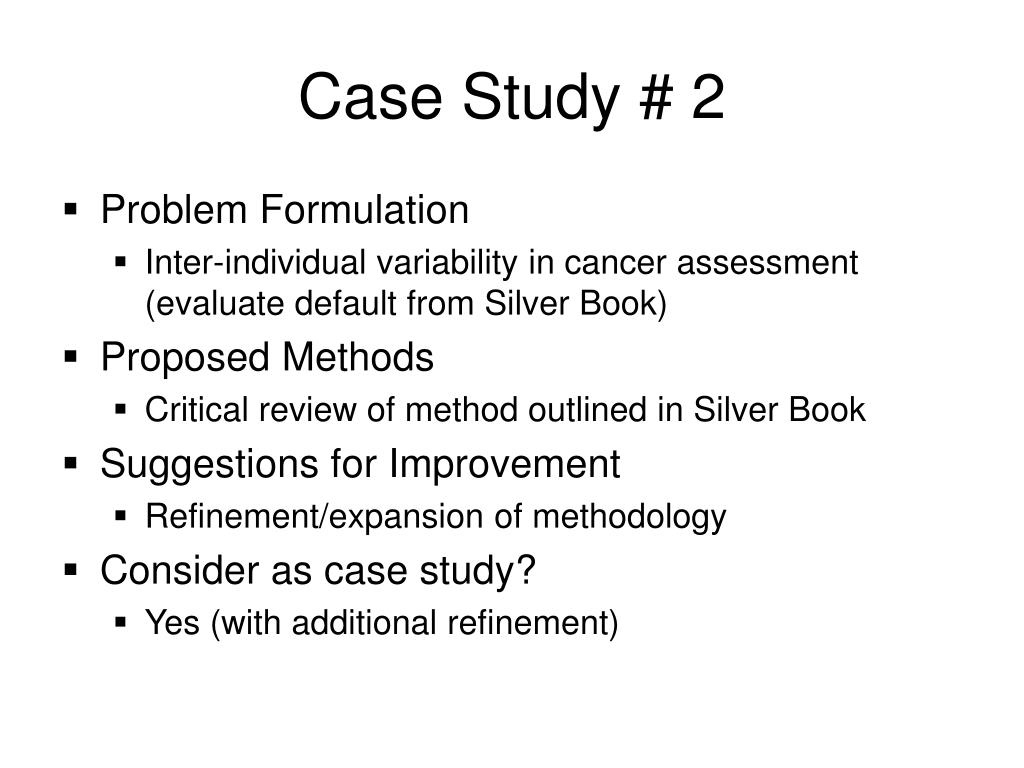
Case Study # 2. Problem Formulation Inter-individual variability in cancer assessment (evaluate default from Silver Book) Proposed Methods Critical review of method outlined in Silver Book Suggestions for Improvement Refinement/expansion of methodology Consider as case study?
Case Study # 2 - slide 1
01 / 8Case Study # 2
1 / 17

Télécharger la présentation

Case Study # 2
Une image / un lien ci-dessous est fourni (tel quel) pour télécharger la présentation

Politique de téléchargement : le contenu du site vous est fourni TEL QUEL pour votre information et votre usage personnel ; il ne peut être vendu, concédé sous licence ni partagé sur d’autres sites sans l’accord de son auteur.Le contenu vous est fourni TEL QUEL, pour votre information et votre usage personnel uniquement. Téléchargez la présentation en cliquant sur ce lien. Lors du téléchargement, si vous ne parvenez pas à télécharger une présentation, l’éditeur a peut-être supprimé le fichier de son serveur.Pendant le téléchargement, si vous ne parvenez pas à obtenir une présentation, le fichier a peut-être été supprimé par l’éditeur.

F I N

Plus de contenu associé

Transcription de la présentation
  1. Case Study # 2 • Problem Formulation • Inter-individual variability in cancer assessment (evaluate default from Silver Book) • Proposed Methods • Critical review of method outlined in Silver Book • Suggestions for Improvement • Refinement/expansion of methodology • Consider as case study? • Yes (with additional refinement)

  2. Case Study # 7 • Problem Formulation • Preexisting disease and low dose linear non cancer response • Proposed Methods • Critical review of methodology provided in Silver Book • Suggestions for Improvement • Provide methodology for evaluating this question • Consider as case study? • No (not in its current form)

  3. Case Study # 10 • Problem Formulation • Uncertainty in dose-response assessment • Proposed Methods • Using sensitivity analyses, compare the uncertainty associated with the BBDR model for formaldehyde with default methods • Suggestions for Improvement • Could be combined with PBPK model for formaldehyde • Consider as case study? • Yes

  4. Case Study # 23 • Problem Formulation • Species differences in metabolism • Proposed Methods • Evaluate the differences in metabolism for 1,3-butadiene and the impact on disease outcomes • Suggestions for Improvement • Consider as case study? • Yes

  5. Case Study # 23.2 • Problem Formulation • Using human data in cancer risk assessment • Proposed Methods • Epidemiological investigations of 1,3-butadiene and leukemia • Suggestions for Improvement • Use MOA to interpret the epidemiology data • Consider as case study? • Yes

  6. Case Study # 25 • Problem Formulation • Developing acute air screening levels • Proposed Methods • TCEQ approaches for developing effects screening levels (pentene as an example) • Suggestions for Improvement • Consider as case study? • Yes

  7. Case Study # 6 • Problem Formulation • Developing screening levels for chemicals with minimal data using structure or class information • Proposed Methods • Proposes using a range of tools including QSAR • Suggestions for Improvement • There may be other relevant tools to consider • Consider as case study? • Yes

  8. Case Study # 1(b) • Problem Formulation • Use of chemical-specific data in lieu of defaults • Proposed Methods • Evaluate approach in Silver Book/EPA’s draft guidance with boron as an example • Suggestions for Improvement • Review guidance from other sources (e.g., IPCS) • Evaluate the uncertainty associated with defaults • Consider as case study? • No (not in its current form)