Download
1 / 6
60 likes | 177 Vues
Explore the Composite Interval Mapping (CIM) program designed for genetic studies. Our guide provides a detailed overview of the CIM process, including data input options for markers and trait data, cumulative marker distance settings, and simulation study parameters. Users can perform QTL searching with specific parameters, analyze data with controlled background markers, and utilize permutation tests to determine significance levels. Optimize your genetic mapping studies with our structured approach and user-friendly options.

E N D
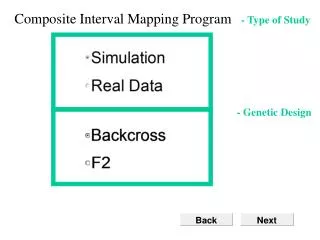
CompositeInterval Mapping Program - Type of Study - Genetic Design
CompositeInterval Mapping Program - Data and Options Cumulative Marker Distance (cM) Map Function QTL Searching Step cM Parameters Here for Simulation Study Only
CompositeInterval Mapping Program - Data Put Markers and Trait Data into box below OR Note: Trait are followed by markers defined in previous cumulative marker distances. Code: 1-mm, 2-mM, 3-MM, No Missing
CompositeInterval Mapping Program - Analyze Data For CIM, Controlled Background Markers by Within cM Or Markers
CompositeInterval Mapping Program - Profile
CompositeInterval Mapping Program - Permutation Test #Tests Cut Off Point at Level Is Based on Tests.