Understanding Earthquakes: Forces, Effects, and Measurement
This chapter explores the nature of earthquakes, highlighting the forces within the Earth that lead to these natural phenomena. It examines how stress and strain cause fractures, details types of faults, and explains the seismic waves generated during an earthquake. Additionally, it covers the study of seismology, how earthquakes are measured and located, and the effects of earthquakes on society, including hazards such as structural failures, land liquefaction, and tsunamis. Understanding these elements is crucial for earthquake prediction and risk management.

Understanding Earthquakes: Forces, Effects, and Measurement
E N D
Presentation Transcript
Chapter 19.1 EARTHQUAKES Forces within earth
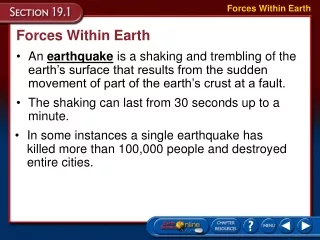
Earthquakes • Natural vibrations of the ground caused by movement along fractures in the crust or volcanic eruptions • Fractures form when stress exceeds the strength of the rock
Types of Stress • Tension- pull • Compression- push • Shear- twist • Strain- deformation caused by stress
Ductile Deformation • Elastic deformation occurs as a result of low stress • Ductile deformation occurs when stress is high • When does fracture occur?
Faults • Fractures in the Earth’s crust along which movement occurs
Types of Faults • Normal- tension • Reverse- compression • Strike-slip- shear
Seismic Waves • (Primary) P-waves- squeeze and pull rocks in the same direction of the waves • (Secondary) S-waves- cause rock to move at right angles to the direction of the waves • Surface waves- cause rock to move up & down
Focus- point where an earthquake originates • Epicenter- point on surface directly above the focus
Chapter 19.2 EARTHQUAKES Seismic waves & earths interior
Seismology • Study of earthquake waves • Seismograph/seismometer- register the vibrations • Seismogram- the record of vibrations
Travel- time • Travel time for P and S waves differ • Can you tell which ones reach a location first? • Where is the biggest difference in the time one wave arrives before the other?
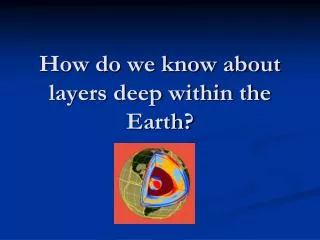
Clues to Earth’s Interior • P waves are refracted in the core • S waves can not travel through liquids • Behavior of waves provide details of Earth’s interior structure and composition
Chapter 19.3 EARTHQUAKES Measuring & locating earthquakes
Earthquake Magnitude and Intensity • Magnitude- the amount of energy released during an earthquake • Richter scale- earthquake rating based on the size of the largest seismic waves • Increases by power of 10 for each magnitude
Moment Magnitude Scale • Most used today • Based on the size of the fault rupture, amount of movement along the fault, and the rocks’ stiffness
Modified Mercalli Scale • Based on the amount of damage done to structures • Measure of intensity
Locating an Earthquake • Distance from epicenter is calculated by comparing the separation time between P and S waves • 3 locations are needed to accurately determine the epicenter of the earthquake • Why?
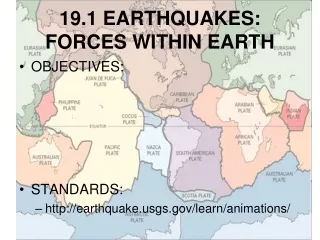
Seismic Belts • 80% occur in the Circum-Pacific Belt • 15% occur in the Mediterranean-Asian Belt
Chapter 19.4 EARTHQUAKES Earthquakes & Society
Earthquake Hazards • Structural Failure • Pancaking • Collapse 2010 Pichilemu earthquake in Chile 1999 Izmit earthquake in Turkey
Earthquake Hazards • Land and Soil Failure • Liquifaction • Seismic wave amplification
Earthquake Hazards • Fault Scarps • Vertical offset
Earthquake Hazards • Tsunamis
Earthquake Prediction • History • Strain Accumulation