Download
1 / 19
190 likes | 329 Vues
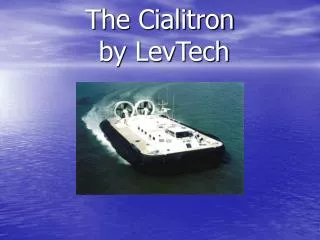
The Cialitron hovercraft from LevTech is engineered for optimal performance with a single operator weight capacity of 200 lbs and a continuous use time of up to 30 minutes. Incorporating dual rudder steering, adjustable lift power, and a durable skirt design, it emphasizes safety with thorough pre-operation inspections and the mandatory use of protective gear. The design includes a reinforced platform, efficient lift engine, and thrust analysis for optimal balance and propulsion. The project also emphasizes risk management through liability waivers for potential riders.

E N D
OPERATION • 30 minutes continuous use by single operator • Maximum operator payload of 200lbs • Steering column mounted thrust throttle • Operator adjusted lift power • Standing position • Dual rudder steering
SAFETY • Lift power adjusted prior to mounting • All motors started and checked prior to mounting • Pre-operation inspection of steering and skirt integrity • Protective gear to be worn • Fan-blade housing • Initial trials conducted with supervision and balance assistance
LIFT FAN ANALYSIS • Air flow vs. rpm curves for various fan manufacturers require a 12 inch fan, 6 and 8 blades, and fixed pitch of 10-15 degrees • A fan of this size needs to rotate at approximately 3600 rpm
LIFT ENGINE • Air pressure and lift calculations with a fan efficiency of 70% and a motor efficiency of 85% require a 2.5HP motor • The lawn mower engine is oversized by approximately 0.3HP to compensate for pressure losses in the skirt, fan, and platform assembly
THRUST ANALYSISFORCES ON HOVERCRAFT • Reynold’s #: • Air Drag: • Exposed surface, plate approximation: 1.1mX1.6m • μkassumed to be ~ 0.04
THE GOVERNING EQUATION • Newton’s 2nd Law: • After solving differential eq. and taking t to gives max velocity • Select a fan that satisfies the constraints
SELECTION OF FAN AND MOTOR • 30’ diam. 2 blades, 6 hp, 1725 max rpm, 9500 max cfm, 13 degree pitch • Eq. yields 6 max mph • The important properties that affect hover speed: weight, kinetic friction, and fan volumetric flow rate and diameter
SELECTION OF THRUST ENGINE • Gas engine with at least 4.5 hp • Engine inefficiency: need 5.5-6 hp • 6.4 hp, ¾’’ diameter shaft, 4 stroke, electric start, on/off start, choke, and throttle • 16.9 L x 13 W x 13.8 H, 55 lbs
PLATFORM DIMENSIONS • Dimensions for the plywood platform are 2.5’ x 6.25’ • 6” extended outrigger system maintains the necessary space for all equipment and the rider • Balance was a contributing factor in the sizing of the platform
STRESS ANALYSIS • Max Moment = PL/4 • Max Stress MY/I = 535 PSI • Yield Stress of wood = 4,350 PSI • Safety Factor ~ 8
CONTROLS • Rudders swing side to side by moving handlebars • Rudders attached with door hinges and supported by rod • Throttle cables for lift and thrust engine attached to handlebars
SKIRT DESIGN • Pliable and Durable • Material: Reinforced nylon from a whitewater raft • Attached to outrigger and base to form semi-circle ring • Reinforced holes
BUDGET *We currently have a useable engine for lift, but, since it cannot be left on the Cialitron after the final demonstration, we are looking for a permanent engine
WAIVER AND RELEASE Since our project has a notable risk of injury to the person and property of the rider, we thought it best to draft a waiver releasing Columbia University from liability for any/all injury sustained while riding the Cialitron. All members of LevTech have signed this waiver. Any person wishing to ride the Cialitron must sign a waiver.
Where do we go from here? Next Steps: • starting fabrication of the parts for which we currently have materials (including the lift engine) • ordering parts from McMaster et al. • continuing our aggressive search for engines that fit within our budget • increasing the intensity of our donation campaign
REFERENCES • Baker, Russell, et al. “Solar Splash 2002 Columbia University Technical Report Boat #13.” Columbia University, 1 May 2002. • Beaty, William J. “Ultra Simple Hovercraft.” Science Hobbyist. 1997 <http://www.amasci.com/amateur/hovercft.html>. 27 Jan 2005. • “A Comparison of Different Hovercraft Lift, Thrust and Transmission Systems.” Airlift Hovercraft.<http://www.airlifthovercraft.com/HC%20Lift%20&%20Thrust%20Systems.htm>. 29 Jan 2005. • “Episode 17: Elevator of Death, Levitation Machine.” Mythbusters. 6 Oct 2004. The Discovery Channel, 29 Jan 2005. • “Hovercraft Theory.” Ben’s Hovercraft. 24 Sept 2003 <http://www.rchovercraft.com/theory.html>. 27 Jan 2005. • Kurtus, Ron. “Determining the Coefficient of Friction”. School for Champions. 15 Dec 2002. 8 Feb 2005. <http://www.school-for-champions.com/science/frictioncoeff.htm>. • McMaster-Carr Supply Company. 2005. 8 Feb 2005. <http://www.mcmaster.com/>. • P. Ponk Aviation. “Propeller Tip Speed Calculator.” Hoverhawk. 10 Feb 2005. <http://www.hoverhawk.com/propspd.html>. • Vawter, Richard. “Drag Force in a Medium.” Western Washington University. Dec 2005. 10 Feb 2005. <http://www.ac.wwu.edu/~vawter/PhysicsNet/Topics/Dynamics/Forces/-DragForce.html>. • White, Frank M. Fluid Mechanics. Fifth Edition. New York: McGraw-Hill, 2002.