Understanding Cultural Sensitivity in Canadian Education: Pillars and Values
320 likes | 419 Vues
Explore the 4 pillars of cultural sensitivity, time, responsibility, control, and values in Canadian education. Learn to navigate cultural differences and enhance the international student experience in the classroom environment.


Understanding Cultural Sensitivity in Canadian Education: Pillars and Values
E N D
Presentation Transcript
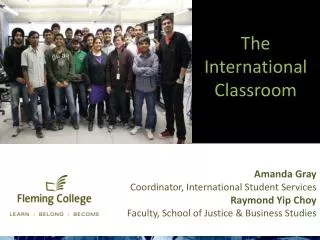
The International Classroom Amanda Gray Coordinator, International Student Services Raymond Yip Choy Faculty, School of Justice & Business Studies
Why This Session? • An enriched college community • Some teething pains
This Session: a start……. • 4 Pillars of Cultural Sensitivity • How Many • Our Stance • Our Collective Experience to Date • The Way Forward – consistent approach, some tools • Continued Shared Learning • Recommendations – ongoing
Canadian Culture:Four Cultural Pillars Time Control Self Responsibility Created with material from Education Abroad Program. QUIC
Self • INDIVIDUALIST • Individualistic: looking out for one’s self protects others • Personal fulfillment is the greater good • Independence and self-reliance are highly valued • Personal space (individualist vs. collectivist) Created with material from Education Abroad Program. QUIC
Responsibility • UNIVERSALIST • Honesty • Being fair and consistent is important • Favouritism is frowned upon, specifically when hiring • Ethics do not change: ethics are ethics at all times • People succeed because of what they do, not who they know (universalist vs. particularist) Created with material from Education Abroad Program. QUIC
Time (monochronic vs. polychronic) • MONOCHRONIC • Punctuality • Every minute counts • Wait on one person at a time • Action-oriented “workaholics” • Schedule social activities and time with family into your calendar • Interruptions are a nuisance Created with material from Education Abroad Program. QUIC
Control (internal vs. external) • INTERNAL FOCUS • No limits on what you can do/become • Every problem has a solution • Change is a constant: there are few things that can’t be changed • Unhappiness is one’s own fault • Life is what you make it Created with material from Education Abroad Program. QUIC
Values of Canadians • Time • Space • Efficiency – Practicality • Individualism • Competition • Informality • Directness, Openness, Honesty Created with material from Education Abroad Program. QUIC
Values of Canadians • Action Orientation • Change • Future Orientation • Materialism • Personal Control over Environment • Equality • Life Created with material from Education Abroad Program. QUIC
+23% +47% +23% Source: Higher Education Quality Council of Ontario International Students Registered in Ontario colleges
At Fleming College - How many This past year 14 • India 123 • Mexico 9 • China 3 • Great Britain 2 • Korea 2 • Finland 2 • Zimbabwe 1 • USA 1 • Brazil 1 • Pakistan 1 • Tunisia 1 • Netherlands Antilles 1 • Russia 1 • Italy 1 countries
How many: then, now & in the future Upcoming ? • 2012/2013 149 • 2013/2014 274 * as of April 4 • Expecting 5 – 10 more from China • Top 5 programs to date • Bio-tech forensic • International Business Management • Project Management • Pharmacy Tech • Wireless Networking • Next on the list • Frost…… • 4.5% of enrollment now, • 10% in next several years
Who are these people? On paper • BA or BSC, MA, MBA, MSC, Pharmacists, Engineers, Lawyers • Most direct, some transfer and exchange • Very diverse backgrounds • International English Language Testing System 6.0 • Canadian Academic English Language 60% overall
Our stance: as a college, in the classroom College • Position Fleming as a destination for a positive international student experience • Identify appropriate international markets • Actively recruit in those areas Students • Most see Fleming as a stepping stone to stay in Canada • Some engage in the learning process In the Classroom • Enable faculty and students to embrace the richness of a wide cultural experience • Continue to meet or exceed student and college expectations
A short team exercise • Case 1, 2, 3 15: minutes to read and make group notes • 15 minutes to share • List of issues arising • List of solutions
Our collective experience to date What are the differences? • We are at home, they are not • Culture clash/understanding • Language proficiency • Education style: passive vs. active, directed vs. independent • Asking questions – considered disrespectful or an admission of ignorance • Education equivalency/consistency • Domestic/International mix
Our collective experience to date Faculty Implications More detailed More observant Culturally aware Consistent Do they conform to Fleming norms? Does Fleming adapt to a new norm?
The way forward Establish your ground rules at start of the class – in course outline and on course page • Punctuality • Attendance • Language in class • Devices • Accessibility • Cultural signals
The way forward Establish Academic Expectations • Provide examples of research (maybe a specific assignment) • Provide examples of proper citation (maybe a specific assignment) • Bring in librarian as a guest speaker • Provide examples of good previous work and explain why it is good • Have low value quizzes, assignments where you can issue a zero without jeopardizing the final grade unduly • Clearly explain assessment plan and implications for missing marks
The way forward Quizzes, Tests, Exams • Change order of multiple choice answers • Change order of questions • Change sense of questions • All same response • Number test papers • Assign seating plan • Absolutely no talking
The way forward Assignments • Build complexity as semester goes on • Provide test assignments or ability to re-do assignments so they can see what is required • Weight individual work more heavily than group work
The way forward Group Work • Group selection – try different methods • Mix them up periodically • Monitor regularly and closely • Element of individual work • Watch for interaction between different ethnicities, religions, genders, regions • Actively look for the workers vs. the coasters • Consider putting workers together
What happens when international students want a letter of reference?
The Way Forward • Regular consultation amongst faculty and staff • Ideas on handout • Continued sharing of experiences and best practices – how?