Demonstration Model for Studying P-Waves and Newton's Laws of Motion
This educational demonstration model engages 8th-grade science students in exploring the principles of force, motion, and energy through the study of P-waves and Newton's three laws. By constructing a layered model with microphones, students will visualize and analyze how waves move through different materials. The hands-on experiment allows them to test hypotheses, gather data, and discuss the effects of various layers (gravel, gelatine, etc.) on wave propagation. Comprehensive resources and visual aids support the learning process, enhancing students’ understanding of scientific concepts.

Demonstration Model for Studying P-Waves and Newton's Laws of Motion
E N D
Presentation Transcript
Demonstration Model Lee Keyes, Shawn Hutcherson 7/13/11
Science Standards, 8th Grade, Texas • Science, as defined by the National Academy of Sciences, is the "use of evidence to construct testable explanations and predictions of natural phenomena, as well as the knowledge generated through this process." This vast body of changing and increasing knowledge is described by physical, mathematical, and conceptual models. Students should know that some questions are outside the realm of science because they deal with phenomena that are not scientifically testable. • (C) Force, motion, and energy. Students experiment with the relationship between forces and motion through the study of Newton's three laws. Students learn how these forces relate to geologic processes and astronomical phenomena. In addition, students recognize that these laws are evident in everyday objects and activities. Mathematics is used to calculate speed using distance and time measurements.
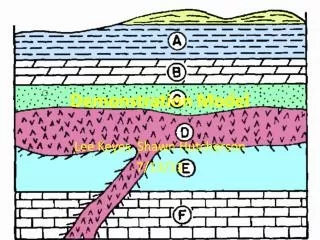
Proposal • Design a demonstration model for student use. • Layered model with microphone used to demonstrate P waves
Materials Needed • Pexi-glass for walls and sides of model • 2 microphones wired to stereo microphone so as to split the signal. • Drill with ¼” drill bit • Lengths of ¼” pvc • Pvc cement or silicone sealant. • Materials for layers • Grout, concrete, sand, gravel, gelatine
Introduction • http://www.ucar.edu/learn/1_5_2_22t.htm • Show Ketering animations and discuss types of waves and what kinds of wave they will be observing, http://www.kettering.edu/physics/drussell/Demos/waves/wavemotion.html • Use slinky to demonstrate physically how waves move for visual effects.
Instructions for Students • Make predictions for each layer on table. • Open wav file on computers • Place 1 microphone on surface • Place second microphone in hole at level you wish to test. • Strike end of tank with rubber mallet. • Copy wave file to sonic visualizer • Repeat for each layer • Compare p-wave sine • Report findings in comparison to previous demonstrations and explain why waves may be different at each level.
Bibliography • http://www.ucar.edu/learn/1_5_2_22t.htm • http://www.kettering.edu/physics/drussell/demos.html • http://www.sonicvisualiser.org/