Measuring Angles
Dive into the world of angles with our comprehensive lesson on angle measurement and classification. Discover the historical roots of degrees developed by the Babylonians and learn how a circle is divided into 360 degrees. This lesson covers classifications including acute, right, obtuse, and straight angles, along with definitions of complementary, supplementary, and linear pairs. Master the use of protractors for measuring angles and understand angle congruence. Engage with practice problems to reinforce your knowledge and skills in geometry.

Measuring Angles
E N D
Presentation Transcript
Measuring Angles Lesson 1.3
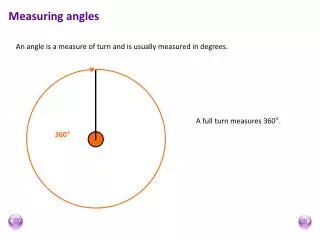
Definition of degree Degrees were developed by the Babylonians thousands of years ago. They divided a circle into 360 parts and called each part one degree.
Notation for angle measurement The symbol for degrees, as you probably already know, is a small superscript circle. 45° 112° 37°
Classification of Angles • Acute Angles • Right Angles • Obtuse Angles • Straight Angles
Definition • Acute angles angles that measure less than 90°
Definition • Right angles angles that measure 90° Symbol for right angles
Definition • Obtuse angles angles that measure more than 90° but less than 180°
Definition • Straight angle an angle that makes a straight line and measure 180°
Angle congruence Angles are congruent if they have the same measure 48° A 48° B
Angle congruence Angles are congruent if one can be moved onto the other so that they match exactly.
Marking Congruent Angles and Sides with Tick Marks. A D B C E F AB DE A D BC EF B E C F AC DF
Pairs of Angles • Complementary Angles • Supplementary Angles • Linear Pair
Definition • Complementary angles Two angles that total 90 degrees 30 and 60 27 and 63 12 and 78
Definition • Supplementary angles Two angles that total 180 degrees • and 155 • 67 and 113 • 124 and 56
Definition • Linear angles Two angles that share a side and make a line. Linear angles total 180° Similar to Supplementary
Angle addition postulate If point S is in the interior (middle) of angle PQR, then the measure of PQS + measure of SQR = measure of PQR S P Q R
Angle addition postulate • Practice Problems • Page 32 # 36-44
Assignment • A4 • Worksheet 1.3 • pp. 30-32 # 13, 27-44