SlideServe
Menu
Préférences
© SlideServe · v2026

Earth's Atmosphere and Evolution: Composition, Pressure, Dynamics

salvadorlane avatar
19 diapositives · 265 Views · Jan 03, 2020

Explore the composition and evolution of the atmosphere, from volcanic eruptions to atmospheric pressure and density. Delve into topics like temperature distribution, gas laws, hydrostatic balance, and the formation of the ozone layer.
Earth's Atmosphere and Evolution: Composition, Pressure, Dynamics - slide 1
01 / 19Earth's Atmosphere and Evolution: Composition, Pressure, Dynamics
1 / 17

Télécharger la présentation

Earth's Atmosphere and Evolution: Composition, Pressure, Dynamics
Une image / un lien ci-dessous est fourni (tel quel) pour télécharger la présentation

Politique de téléchargement : le contenu du site vous est fourni TEL QUEL pour votre information et votre usage personnel ; il ne peut être vendu, concédé sous licence ni partagé sur d’autres sites sans l’accord de son auteur.Le contenu vous est fourni TEL QUEL, pour votre information et votre usage personnel uniquement. Téléchargez la présentation en cliquant sur ce lien. Lors du téléchargement, si vous ne parvenez pas à télécharger une présentation, l’éditeur a peut-être supprimé le fichier de son serveur.Pendant le téléchargement, si vous ne parvenez pas à obtenir une présentation, le fichier a peut-être été supprimé par l’éditeur.

F I N

Plus de contenu associé

Transcription de la présentation
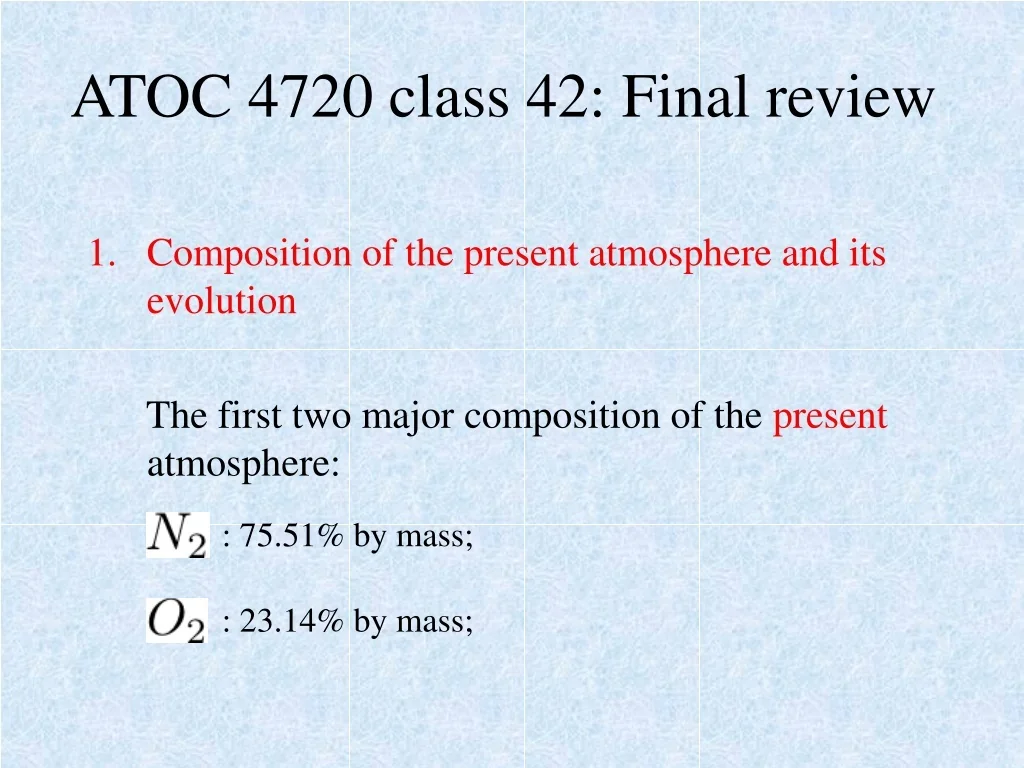
  1. ATOC 4720 class 42: Final review • Composition of the present atmosphere and its evolution The first two major composition of the present atmosphere: : 75.51% by mass; : 23.14% by mass;

  2. Evolution: The earth formed first, and its present atmosphere are believed to be evolved from the volatile substance from volcanic eruption. Major composition of the raw atmosphere due to volcanic eruption: 85% , and 10% light

  3. 2. The distribution of atmospheric pressure and density Where : 7-8 km; scale height;

  4. 3. The fair weather elecric field and charged particles Charged Particles: important for lightening, reflection of radio waves, fair weather electric field, etc + + + + + + + + + - - - - - - - - - - - - -

  5. 4. Temperature distribution with height

  6. 5. Gas laws For a unit mass dry air: For unit mass of moist air: Where Virtual temperature

  7. 6. The hydrostatic equation Large scale atmospheric motions satisfy hydrostatic balance. Balance between the upward PGF and the downward gravitational Force. PGF Gravity

  8. 7. The geopotential and geopotential height : the work that must be done against the earht’s Gravitational field in order to raise a mass of 1kg From sea level to that point. J/kg. Geopotential height:

  9. 8. The hypsometric equation Warm air: thicker Cold air: thinner;

  10. 9. The first law of thermodynamics Applies for both diabetic and adiabatic processes. Diabetic: heat absorbed by a substance is used either to increase its internal energy or used to do external work. Adiabatic: dq=0. [1] Adiabatic expansion; [2] Adiabetic compression;

  11. 10. Lifting condensation level (LCL) The lifting condensation level is defined as the level to which a parcel of moist air can be lifted adiabatically before it becomes saturated with respect to a plane surface of water. LCL -- well defined cloud base.

  12. 11. Static stability and level of free convection Conditionally unstable; Level of free convection x Height LCL Temperature

  13. : unstable; T1=T1e; then T2>T2e T2e T2 T1 T2e : stable; Convectively unstable; T inversion layer;

  14. 12. Atmospheric aerosols Effects on cloud and precipitation: CCN; Should know why. Homogeneous nucleation is difficult to grow big; Atmoshperic electricity, radiation, chemistry.

  15. 13. Hurricanes Dynamics: CISK; Air/sea interaction; Thermally direct Circulation: Available Potential Energy (PE) Is converted to Kinetic energy (KE). Maintenance: warm Core maintenance-- PE--KE;

  16. 14. Radiation Wien displacement law: Stefan-Boltzmann law: Kirchhoff’s law:

  17. Top: 100% in 30% reflection 38%+26% atm emits; 6% IR emits Earth; 15. The global energy balance Atm: 16%+3% SW abs; 15% IR abs; 7% abs sensible; 23% abs latent; 38% emits molecules; 26% emits clouds; Surface: 51% in; 23% latent; 7% sensible; 21% IR;

  18. 16. Photoionization, photodissociation of oxygen, and fromation of ozone layer Upper thermosphere, photoionization of molecules and atoms Produces ionosphere, absorbs solar radiation: Photodissociation above 100km: Ozone is not formed in this high level however; mean free path Large, 3 body collision chance is small.

  19. 20-60km: O is trace but important for ozone formation. Three body clission chance is large because mean free Path is small. Then, Reduce UV, Ozone layer protects the earth plants etc.