Ionization Energy
60 likes | 183 Vues
Ionization energy is the energy required to remove an electron from an atom, overcoming the nuclear charge's attraction. It is an endothermic process, always yielding positive values. Trends indicate that ionization energy increases across a period and decreases down a column. The interplay between electron-nuclear attraction (Z*) and electron-electron repulsion plays a crucial role in determining these trends. For instance, oxygen's electron configuration leads to greater electron-electron repulsion within its orbitals, making it easier to lose an electron compared to nitrogen.


Ionization Energy
E N D
Presentation Transcript
Ionization Energy UDZ, Rajiv(who has a question)James Ankit cool brain
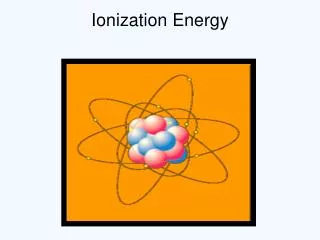
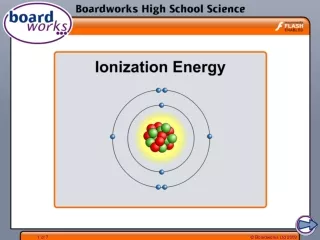
Ionization Energy • Ionization Energy is energy required to remove an electron from the atom • To separate electrons from atoms, a sufficient amount of energy is needed to overcome the attraction of nuclear charge • Since ionization NEEDS energy to overcome the attraction, it is considered an endothermic process and its values are ALWAYS positive. • Example of Magnesium
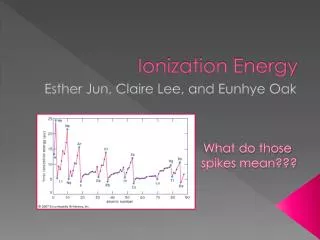
Trend • Ionization Energy INCREASES across a period • Ionization Energy DECREASES down a column
Key Factors Controlling the Trends • The ionization energies of atoms is a balance between electon-nuclear attraction aka Z* and electron-electron repulsion.
Electron-Electron Repulsion • The reason for exceptions to the trend is electron-electron repulsion. • Lets take Oxygen for example • The electron configuration for Oxygen is 1s2 2s2 2p4 • This means that one of the 3 orbitals in the P shell has two electrons inside, while the other 2 orbital only has 1 electron. The orbital with 2 electrons undergoes an electron-electron repulsion thus making it easier for Oxygen to lose that 1 electron compared to Nitrogen which has 1 electron in each of the P orbitals and would not have an electron-electron repulsion.