The Behavior of Waves
260 likes | 391 Vues
This resource explores the fundamental behaviors of waves, including speed changes when encountering new media, reflection, and how waves bend through refraction and diffraction. Concepts of resonance, interference, and the Doppler effect are examined, illustrating the interaction of waves with different factors. Learn how waves reflect off surfaces, change direction when meeting barriers, and the phenomenon of standing waves. Utilize interactive links and videos to enhance understanding of these principles in physics.


The Behavior of Waves
E N D
Presentation Transcript
Wave Speed • Remember: Waves change speed when they encounter a boundary and enter a new medium
Wave Speed • http://www.nisdtx.org/Page/42568 • Click on the above link and select the video Wave Speed
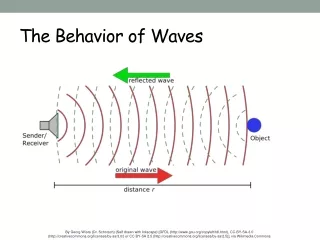
Reflection • Reflection- when a wave strikes an object and bounces off of it • All types of waves can be reflected • Light, sound, ocean, etc. • Used by bats and dolphins • All types of waves can be reflected • The angle of incidence of a wave is always equal to the angle of reflection. • http://www.acs.psu.edu/drussell/Demos/reflect/reflect.html
Reflection • Normal- an imaginary line perpendicular to the reflective surface • Angle of Incidence- the angle formed by the wave striking the surface and the normal • Angle of Reflection- the angle formed by the reflected wave and the normal
Refraction • Why does an object partially in the water look broken or disconnected? • Refraction- the bending of a wave caused by a change in the speed of the wave as it moves from one medium to another • Greater change in speed = more bending of the wave • When a wave moves into a medium that slows it down, the wave is bent toward normal • When a wave moves into a medium that allows it to speed up, the wave is bent away from normal
Refraction • http://www.ps.missouri.edu/rickspage/refract/refraction.html • http://www.physicsclassroom.com/mmedia/waves/ltm.html • http://www.physicsclassroom.com/mmedia/optics/bp.html
Diffraction • Diffraction- an object causes a wave to change direction and spread around or through a barrier • Refraction and diffraction both cause bending, but refraction occurs when waves enter a new medium, while diffraction occurs when waves pass around something while still in the same medium
Diffraction • http://www.walter-fendt.de/ph14e/singleslit.htm • http://www.colorado.edu/physics/2000/schroedinger/two-slit2.html
Resonance • Resonance- the ability of an object to vibrate by absorbing energy at its natural frequency • Breaking a glass with sound- resonance: http://www.teachersdomain.org/resources/lsps07/sci/phys/energy/glassbreak/index.html
Tacoma Narrows Bridge • Click the below link to watch the Tacoma Narrows Bridge Video • http://www.nisdtx.org/Page/42568
Breaking Glass • Click on the link below to watch the Breaking Glass video • http://www.nisdtx.org/Page/42568
Interference • http://www.acoustics.salford.ac.uk/feschools/waves/diffract.htm • Interference- the ability of two or more waves to overlap and combine to form a new wave • Waves pass right through each other and continue to travel in their original directions • A new wave exists only while the two original waves continue to overlap • Constructive interference- waves add together • Destructive interference- wave subtract from each other
Interference • http://id.mind.net/~zona/mstm/physics/waves/interference/intrfrnc.html
Standing Waves • Standing waves- a wave pattern that stays in one place • Forms when waves of equal wavelength and amplitude travel in opposite directions- continuously interfering with each other • Nodes- places where the two waves always cancel each other • http://id.mind.net/~zona/mstm/physics/waves/standingWaves/standingWaves1/StandingWaves1.html • http://www.walter-fendt.de/ph14e/stwaverefl.htm
Doppler Effect • Link on the link below to watch the video about the Big Bang Doppler Effect http://www.nisdtx.org/Page/42568
Doppler Effect • http://www.youtube.com/watch?v=Tn35SB1_NYI • The change in frequency when there is relative motion between an observer of waves and the source of the waves • Doppler with Sound
The Doppler effect- Change in frequency due to the source or receiver greater the speed the source, greater the Doppler effect Bug swimming Stationary bug Blue Shift-increase in frequency Red Shift- Decrease in frequency
Doppler Effect • Blue Shift-increase in frequency Red Shift- Decrease in frequency
Red Shift • Click on the link below to watch the video about Red Shift • http://www.nisdtx.org/Page/42568
Bow waves • V-shaped pattern made by overlapping crest
Shock Waves Produced by supersonic aircraft, three-dimensional cone shaped Sonic boom – sharp crack heard when conical shell of compressed air that sweeps behind a supersonic aircraft reaches listeners on the ground below.
Supersonic • Subsonic - slower than the speed of sound • Supersonic- faster than the speed of sound