Ethanol
Ethanol. Megan Sparks Bevon Flansburg Steph Hyde Annie Brandjord Cristen McLean. O. H. O. H. H. C. C. H. H. H. H. C. What is Ethanol?. I’m cute!. (http://en.wikipedia.org/wiki/Image:Ethanol-3D-vdW.png). What Is Ethanol Fuel?. E10: 10% ethanol 90% gasoline.

Ethanol
E N D
Presentation Transcript
Ethanol Megan Sparks Bevon Flansburg Steph Hyde Annie Brandjord Cristen McLean
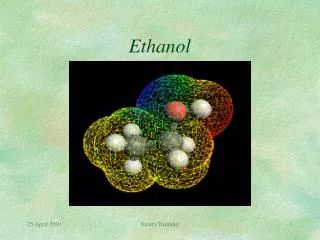
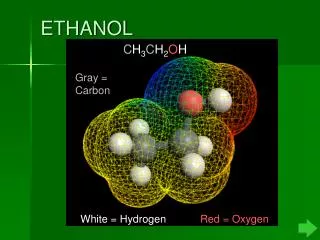
O H O H H C C H H H H C What is Ethanol? I’m cute! (http://en.wikipedia.org/wiki/Image:Ethanol-3D-vdW.png)
What Is Ethanol Fuel? E10: 10% ethanol 90% gasoline. E85: 85% ethanol 15% gasoline. E85 can be used in flexible fuel vehicles (FFVs). (http://www.ethanol.org)
Grain Ethanol “Ethanol” generally means grain alcohol. Sources: corn (primary source in U.S.) other grains potatoes sugarcane (e.g. Brazil) (http://www.ethanol.org)
Cellulosic Ethanol Cellulosic ethanol is made from cellulose (surprise!) Cellulose provides structure to plants. Sources: corn stover, sugar cane bagasse, sawdust, paper pulp, and switchgrass. (Brekke 2005) (http://en.wikipedia.org/wiki/Image:Cellulose-3D-balls.png)
Making Grain Ethanol (Dry Milling) • Milling (grind it up!) • Liquification (mixed with H2O and heated) • Saccharification (starch fermentable sugars) • Fermentation (yeast + sugars = ethanol + CO2) • Distillation (ethanol is separated from the solids) • Dehydration (remove last bit of H2O) • Denaturing (made unfit for human consumption) • Co-products (distiller’s grain livestock feed • CO2 compressed) (http://www.ethanol.org)
Cellulose to Fermentable Sugars • Treat with heat and acid to break it apart • Treat with enzymes to turn the sugars into fermentable glucose • Enzymes now 10-18 cents / gallon in laboratory trials. Bacteria…? Lonnie Ingram (University of Florida) E. coli + cellulose ethanol 90 – 95 % efficiency (Brekke 2005) www.fuga.ru/tok/2003/11/e-coli-small.jpg
Energy Efficient Yields 25 % more energy than is used to grow, harvest and distill it into ethanol. Energy output:input ratio = 1.6 (http://www.eere.energy.gov/afdc/altfuel/eth_energy_bal.html)
Gasoline vs. Ethanol (http://www.eere.energy.gov/afdc/progs/fuel_compare.cgi)
Emissions and Air Quality • Ethanol contains 35% oxygen. Adding oxygen to fuel results in more complete fuel combustion • Gasoline containing a 10% ethanol blend reduces smog emissions • carbon monoxide 25-30% • particulate matter 50% • volatile organic compounds 7%. http://www.greenfuels.org/ethanol/envbenefits.htm
Emissions from Ethanol Plants Most ethanol plants emit < 100 tons of pollutants as compared to >20,000 tons produced by an average-sized power plant each year http://www.ethanol.org/talkingpoints.html
‘Recycling’ CO2 • -CO2 co-product is compressed and sold to carbonate beverages, manufacture dry ice, and flash freeze meat. • Miscible CO2 flooding. http://www.ethanolrfa.org/resource/facts/environment/; http://www.ethanol.org/carbondioxide.html
Feasibility • Since 1999, an increasing number of FFVs manufactured. • Increasing economic feasibility. http://www.eere.energy.gov/afdc/altfuel/ethanol.html
Benefits: Internal Economic • USDA estimates 2012 corn demand= 2 billion Bushels • Plant construction creates 370 local jobs ($60-130M income) • Plant operation creates 4,000 local jobs ($47-100M income)
Benefits: More Internal • Necessary to continue to meet rising EPA standards • 95% of gas already has 6% ethanol
Benefits: External Economic • Self-sufficiency! • Potential 1/3 reduction of foreign oil dependence • W/o E10, immediate 3% need increase
So, Who’s Buying It? • 2003- Global Summit including representatives from China, India, Thailand, and Brazil • “In poor countries, production of ethanol and biodiesel can have an extremely positive impact. It assists in dealing with the energy deficit, influencing internal consumption and exports. It can also generate a vast number of jobs.” - President da Silva, Brazil
E3 Biofuels (Mead, NE) • Grow Corn • Produce Ethanol • Feed Cattle • Harvest the manure • Produce methane • Methane fuels boilers • Remains-Fertlize soil
Domestic Production • American Made Fuel 2006 • 105 plants in operation-1/2 locally owned=5 billion gal/year 48 New or Improved on line=7.9 billion gal/year http://www.usatoday.com/news/nation/2006-10-01-ethanol_x.htm
Annual Projections forCellulosic Ethanol 50 billion gallons Waste (Agricultural, Industrial, MSW) 40%-50% USDA&E Estimate 80 billion gal. potential 1/3 transportation energy By 2050 Switchgrass on 114 million acres 165 billion gal. ethanol=108 billion gal. gasoline http://www.nrdc.org/air/energy/biofuels/contents.asp, www.energy.ca.gov/reports http://www.harvestcleanenergy.org
Natural Resource Defense Council (NRDC)Growing Energy Improve conversion efficiencies 50 to 117 gal. ethanol / 1dry ton of biomass Produce animal proteins from switchgrass (capable of producing I billion tons of sustainable biomass/year) http://www.nrdc.org/air/energy/biofuels/contents.asp, http://www.harvestcleanenergy.org http://www.ethanolrfa.org/resource/cellulose
Goals and Future Usage …Yes, they really are out there.
Implementation of Waste Processing • Industrial waste/municipal solid waste as definite source of energy. • Dartmouth project (paper sludge to ethanol). • Masada Oxynol, Middletown, NY (MSW to ethanol). • Reduces or eliminates capacity problems at wastewater plants and the need for landfills.
Landfill Use • 1990: 247 million tons of non-hazardous waste. • 2001: 409 million tons. • Use of MSW opens new framework of raw materials, minimizes land charted for feedstock cultivation. http://www.zerowasteamerica.org/Landfills.htm
Current proposals • Natural Resource Defense Council: • Invest in research, development, general demonstration ($1.1 billion). • Invest in deployment ($1 billion 2006-2015; prices to approach diesel/regular gasoline). • Adopt policies to establish infrastructure and a market (RF standards, FFV req’s) http://www.nrdc.org/air/energy/pump/contents.asp
Incentives/Laws • State and federal-level tax/loan benefits to encourage the use of alternative fuels. • Mandates require purchase of AFVs whenever economically or logistically possible. www.irs.gov/publications/p378/ar01.html. Table: http://www.nrdc.org/air/energy/rep/chap1.asp